
Best Retreat Venues in New Mexico: How to Choose
You've saved the mountain views, compared cabin photographs, and started a guest list. Now you need to know whether the property you love can support your gathering, including the relatives who need an easy walk to dinner and the colleague who must join a meeting remotely.
The best retreat venues in New Mexico combine a distinctive setting with dependable operations. My recommendation is to choose for purpose first, atmosphere second, and practical readiness before you sign. A beautiful farm, lodge, or resort earns its place on your shortlist when its team can explain how your particular gathering will work.
Table of Contents
- Retreat Venue Types Compared at a Glance
- Smoke, Heat and Elevation Planning for Outdoor Events
- Connectivity and Group Logistics for Remote Retreats
- Historic Cabins and Creative Heritage Near Taos
- Dark Skies and Evening Programming
- Weddings and Gatherings Under New Mexico Rules
- Testing One Historic Farm and Your Shortlist
Retreat Venue Types Compared at a Glance
What kind of property does your group need? Answer that before comparing individual venues. A writing group seeking quiet cabins needs something different from a leadership team running presentations or a couple planning a destination wedding.
Start with the event's nonnegotiables: sleeping arrangements, gathering format, meal coordination, and how much assistance you expect. Don't assume a rural property includes retreat programming, or that a resort's room inventory guarantees suitable group space.
Retreat venue types and their typical strengths
| Venue Type | Typical Strength | Watch For | Best Fit |
|---|---|---|---|
| Historic farm or ranch property | Character, acreage and open space | Indoor backup and whether lodging is on site | Small groups and weddings that value setting |
| Mountain lodge with meeting rooms | Lodging and group space under one roof | Winter access and heating performance | Corporate offsites and multi-day retreats |
| Wellness retreat center | Structured programming and quiet schedules | Program inclusions and meal plans | Yoga, wellness and creative workshops |
| Desert resort | Spa and dining services | Group minimums and room blocks | Milestone celebrations and luxury stays |
| Urban-edge event venue | Easy arrival and shorter drive | Fewer overnight rooms and less privacy | Day workshops and receptions |
Choose the operating model before the scenery
These are typical strengths, not guarantees. A farm might offer excellent gathering infrastructure, while a lodge might require outside vendors for almost everything beyond accommodation. Treat each row as a starting point for questions, not a promise about every property in that category.
For destination weddings and family reunions, I'd favor a property where guests can settle in rather than repeatedly pack up and drive. For yoga and wellness retreats, decide whether you're bringing your own facilitator or purchasing an established program. Those are different bookings, with different responsibilities.
An urban-edge venue may be the better choice for an Albuquerque or Santa Fe day workshop with tightly scheduled arrivals. A rural Northern New Mexico property makes more sense when time together, the surrounding setting, and overnight stays are central to the purpose.
Shortlist rule: Choose the property type that supports the least flexible part of your program.
Pick the category or categories that match your guest count, purpose, and number of nights. Carry those forward, and set aside properties that would require you to redesign the gathering to use them.
Smoke, Heat and Elevation Planning for Outdoor Events
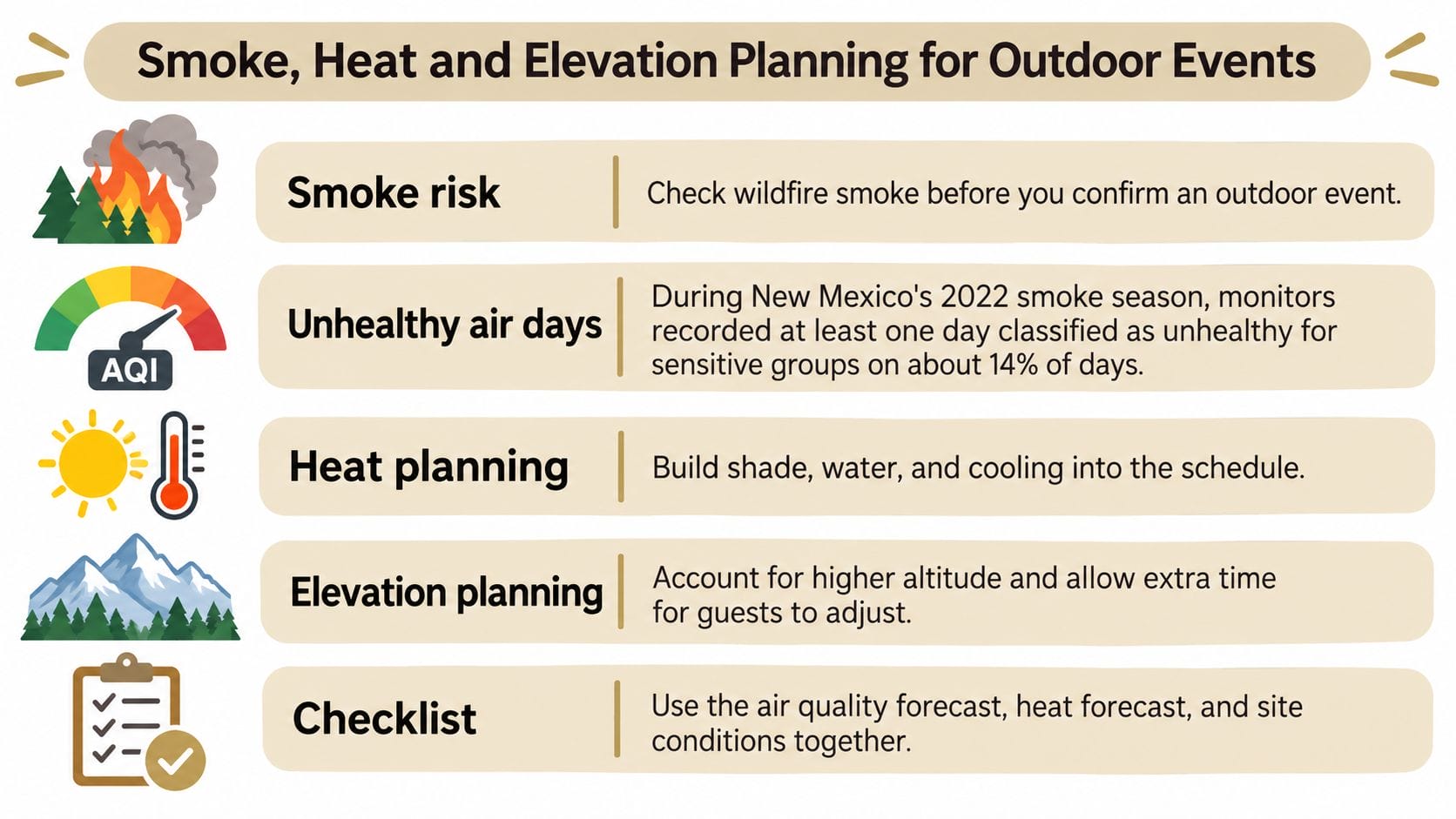
Wildfire smoke deserves attention before flowers, trail maps, or sunset photographs. During New Mexico's 2022 wildfire-smoke season, monitors recorded at least one day classified as unhealthy for sensitive groups on approximately 14% of days, and unhealthy air on 9% of days, according to the GeoHealth study of New Mexico wildfire smoke. The study also describes the New Mexico Environment Department's advice to monitor air-quality information and use the 5-3-1-mile visibility method when assessing outdoor conditions.
Those findings aren't a forecast for your event date. They're a reason to require a credible smoke-day plan, particularly for older attendees, children, people with asthma, and teams that can't lose a workshop day.
Use this outdoor-planning checklist when reviewing a venue's proposal.
Ask about the actual site
Elevation changes the planning conversation. New Mexico ranges from approximately 2,817 feet at Red Bluff Lake to 13,161 feet at Wheeler Peak, according to the New Mexico Economic Development Department's climate and geography guide, so ask for the property's own elevation rather than relying on a statewide description.
Plan gentle arrivals, accessible drinking water, layers for changing temperatures, and shaded rest areas. Don't make strenuous outdoor activity the first obligation after a long travel day. Guests should be able to participate without feeling pressured to push through discomfort.
Require a usable alternative
Ask each venue to address these points in writing:
- Full-group indoor space: Identify a room that accommodates your actual layout, including tables, movement, or ceremony seating.
- HVAC and filtration: Confirm what equipment serves gathering spaces and how it's operated during smoke.
- Shade and enclosure: Locate protected places for breaks and meals.
- Air-quality communication: Name the person responsible for monitoring conditions and notifying guests.
- Decision triggers: Establish when programming moves, pauses, relocates, or cancels.
- Morning activity: Put physically demanding sessions in cooler morning slots.
- Protected circulation: Check covered routes between lodging and meeting areas, including accessible alternatives.
Wildfire planning also means checking evacuation access, vegetation management, and incident communication. The state's Community Mitigation Maps provide location-specific tools for evaluating risk rather than labeling every rural venue alike.
An indoor room isn't automatically a smoke-safe room. Capacity, filtration, and the route guests take to reach it all matter. Ask the venue to describe a smoke day from breakfast through departure, including whether a ceremony can move indoors without losing its scheduled start.
Connectivity and Group Logistics for Remote Retreats
Rural quiet is an advantage until your facilitator can't connect to a remote speaker. New Mexico's 2025 broadband plan reported more than 129,000 residents and businesses remained unserved or underserved; the same state broadband plan reports rural population declined 1.33% between 2020 and 2025, compared with 1.50% growth in urban counties.
That's statewide context, not a verdict on a particular property. It does mean you should replace the question about whether WiFi exists with a more useful one: Can this connection support our actual program?
Request an operational arrival sheet
Before booking, ask for:
- Verified internet performance: Upload and download speeds measured in the meeting room, plus backup connectivity.
- Carrier-specific coverage: Cell reception where guests sleep and gather, not just near the entrance.
- Arrival instructions: Directions, road conditions, parking, shuttle arrangements, and vendor unloading access.
- Accessibility details: Surface conditions, gradients, entrances, bathrooms, and distances between buildings.
- Essential stops: Nearby medical care and grocery options, with clear directions.
- A property layout: Which sleeping rooms and gathering spaces are on the same site.
When permanent connectivity won't support the program, Splash Access's guide to planning temporary WiFi for events is a useful starting point for discussing a temporary network with a specialist. Don't assume rented equipment alone solves an inadequate upstream connection.
Test the work, not just the speed
Ask your facilitator to run a short hybrid-session rehearsal from the proposed room. Have a remote participant join by video while someone on site shares a file and presents slides. Listen for dropped audio and watch for lag, then repeat the test where breakout groups would work.
Also walk the route from accommodation to the meeting room while carrying presentation equipment. Daily drives and awkward transfers consume time you intended for the retreat.
Can this group run its full program here without workarounds?
For corporate offsites, that question should come before the view.
Historic Cabins and Creative Heritage Near Taos
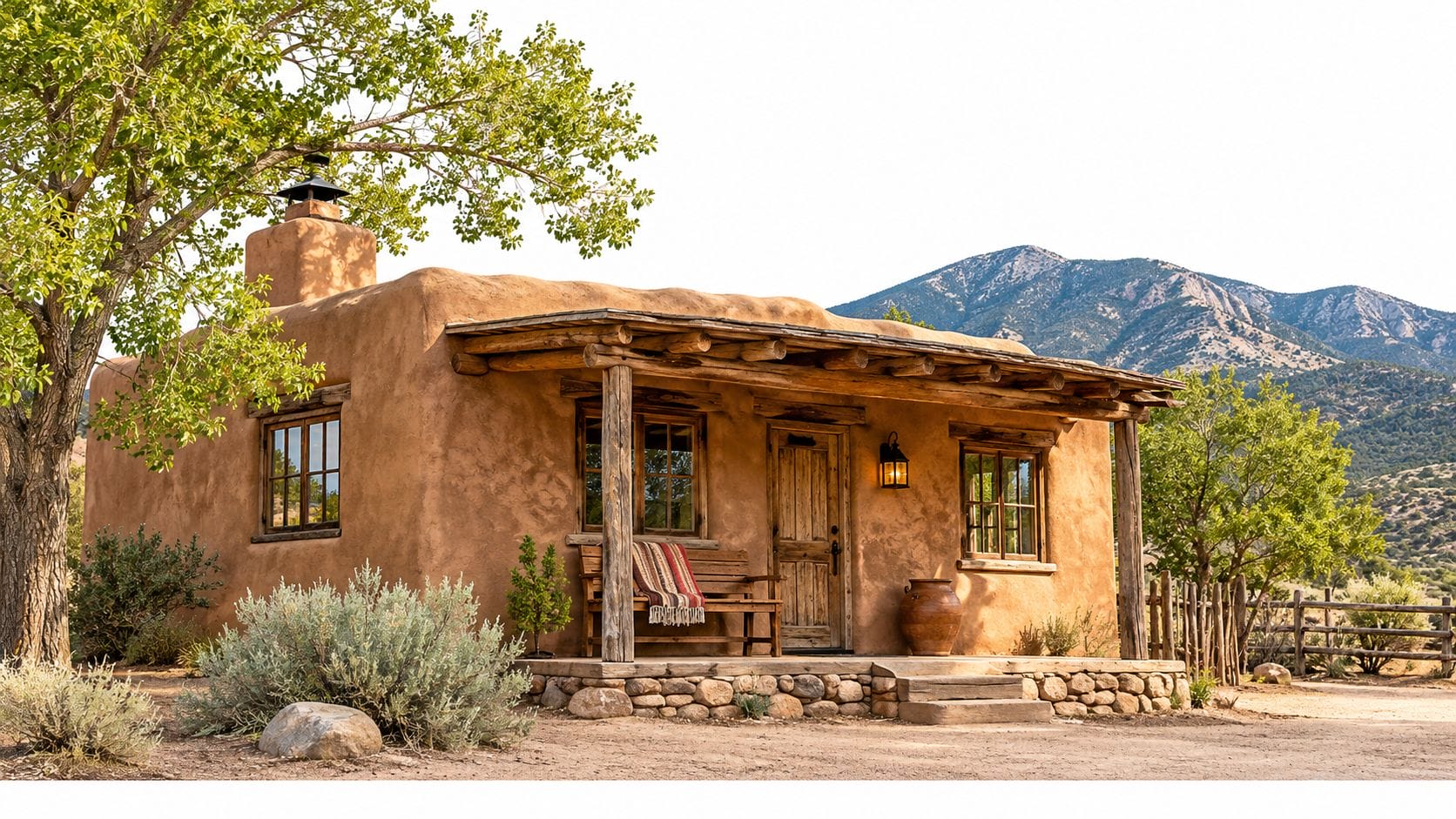
A wooden porch, a textured wall, and morning light across a table can make a cabin appealing before you've unpacked. For a writer, though, the decisive detail might be whether that table supports a comfortable working day. For a workshop leader, it's whether private concentration and shared discussion can coexist.
Look past the exterior when considering a historic stay.
Separate regional heritage from building history
The creative history around Taos is substantial. The Taos Society of Artists was founded in 1915 by artists including Joseph Henry Sharp, E. Irving Couse, and Oscar Berninghaus; The Taos News's history of Taos also identifies D. H. Lawrence, Willa Cather, Georgia O'Keeffe, and Ansel Adams among the writers and artists welcomed through Mabel Dodge Luhan's Taos circle.
That regional story gives a creative retreat context. It doesn't establish that any particular artist slept in any particular cabin. Ask which buildings are original, which were rebuilt, and what documentation supports named associations.
At Taos Goji, our cabins are named after the artists and writers who once stayed here, and the property was once a gathering place for artists, writers, and visionaries. That history is part of our identity, rather than a reason to assign every famous Taos visitor to our buildings.
For another view of the setting, take time with the video.
Match the cabin to the work
Say you're organizing a writing retreat. Give participants private working time, then gather for a reading or critique session rather than filling every hour with instruction. For an artist workshop, check where materials can be stored and whether the proposed workspace suits the medium.
- For solitary work: Ask about desk surfaces, lighting, nearby activity, and privacy.
- For comfortable nights: Confirm heating, beds, bathroom arrangements, and water pressure.
- For shared sessions: Match the room to conversation, demonstrations, or messy materials.
Historic doesn't automatically mean quiet, accessible, or comfortable in every season. Choose the building for what you'll do inside it, not just how it photographs.
Explore our historic cabins and accommodation options to begin matching a stay to your creative purpose. Confirm the particular cabin's configuration before building your schedule around it.
Dark Skies and Evening Programming
Don't treat the evening as leftover time. A quiet reading, an unhurried wedding reception, or an outdoor conversation can give a retreat a different character after sunset, provided guests can move around comfortably.
New Mexico's nine DarkSky International-certified locations are Chaco Culture National Historical Park, Capulin Volcano National Monument, Clayton Lake State Park, Cosmic Campground, El Morro National Monument, Fort Union National Monument, Salinas Pueblo Missions National Monument, Valle de Oro National Wildlife Refuge, and Valles Caldera National Preserve, according to New Mexico DarkSky's certified-place directory. The directory identifies Clayton Lake as the state's first dark-sky park, designated in 2010, with Gold-tier certification and a 14-inch telescope.
Plan for darkness without creating obstacles
Certification belongs to designated places. It doesn't establish the sky quality of every private venue nearby, and these locations shouldn't be treated as convenient evening excursions without checking their distance and access.
For an on-property program, ask about lighting, neighboring light sources, and the view from the actual gathering area. Then walk the route guests will use afterward.
- Protect footing: Identify steps, uneven ground, and changes in surface.
- Use restrained lighting: Discuss shielded path lighting that supports navigation without overwhelming the setting.
- Keep an alternative: Choose an indoor reading or conversation format if outdoor conditions aren't suitable.
Evening-planning test: Could a guest unfamiliar with the property find their room comfortably after the gathering?
Don't promise a spectacular sky on a specific night. Plan an evening that remains worthwhile if clouds arrive, and regard clear views as a welcome part of the experience rather than its only purpose.
Weddings and Gatherings Under New Mexico Rules
Start with the paperwork that can't be skipped. The Santa Fe County Clerk's marriage-license guidance sets out the requirements below, including two witnesses at least 18 years old and return of the completed license within 90 days of the ceremony.
Marriage license requirements in New Mexico
| Requirement | What It Means for Your Ceremony |
|---|---|
| Photo identification | Both applicants appear together and present government-issued photo ID |
| Witnesses | Two witnesses who are at least 18 years old attend the ceremony |
| Officiant | A judge, ordained person or other authorized officiant is arranged separately |
| County flexibility | The ceremony can take place in any New Mexico county |
| Return deadline | The completed license goes back to the issuing county clerk within 90 days of the ceremony |
County flexibility helps destination couples coordinate their application around travel. It doesn't remove the need to arrange an authorized officiant separately or ensure the completed paperwork reaches the issuing clerk. Confirm application logistics directly with that office before making travel commitments.
Work backward from the ceremony
Use this sequence to keep legal and venue decisions aligned:
- Choose the date and guest count. Establish whether you're planning an elopement, micro wedding, or a larger celebration.
- Confirm the ceremony location and indoor alternative. Understand the layout before committing to rentals.
- Book the officiant and coordinate witnesses. Don't leave either responsibility to an informal assumption.
- Apply together for the license. Build the clerk visit into your travel itinerary.
- Set the outdoor schedule. Coordinate the ceremony, photographs, meals, and weather decisions.
- Assign responsibility for returning the completed license. Put that task on the post-wedding checklist.
Keep the celebration workable indoors
A backup ceremony plan should include the aisle, seating, sound, flowers, and where guests wait during a changeover. Ask how an indoor move affects the photo plan and meal service, not merely whether a room exists.
For a seated reception, Wedding Studio's wedding seating chart can help you organize households and guest relationships before you translate that plan into the venue's actual floor layout. Keep accessible routes and service aisles clear.
We host weddings ranging from an intimate elopement to a weekend-long celebration and offer Rustic Farm & Barn wedding packages. Explore our wedding package information, then request a written explanation of what's included for your gathering.
The same attention to circulation, comfort, and timing matters for engagement celebrations, family gatherings, and memorials. Marriage paperwork is specific to the wedding, but a thoughtful host still needs a clear plan for everyone arriving.
Testing One Historic Farm and Your Shortlist
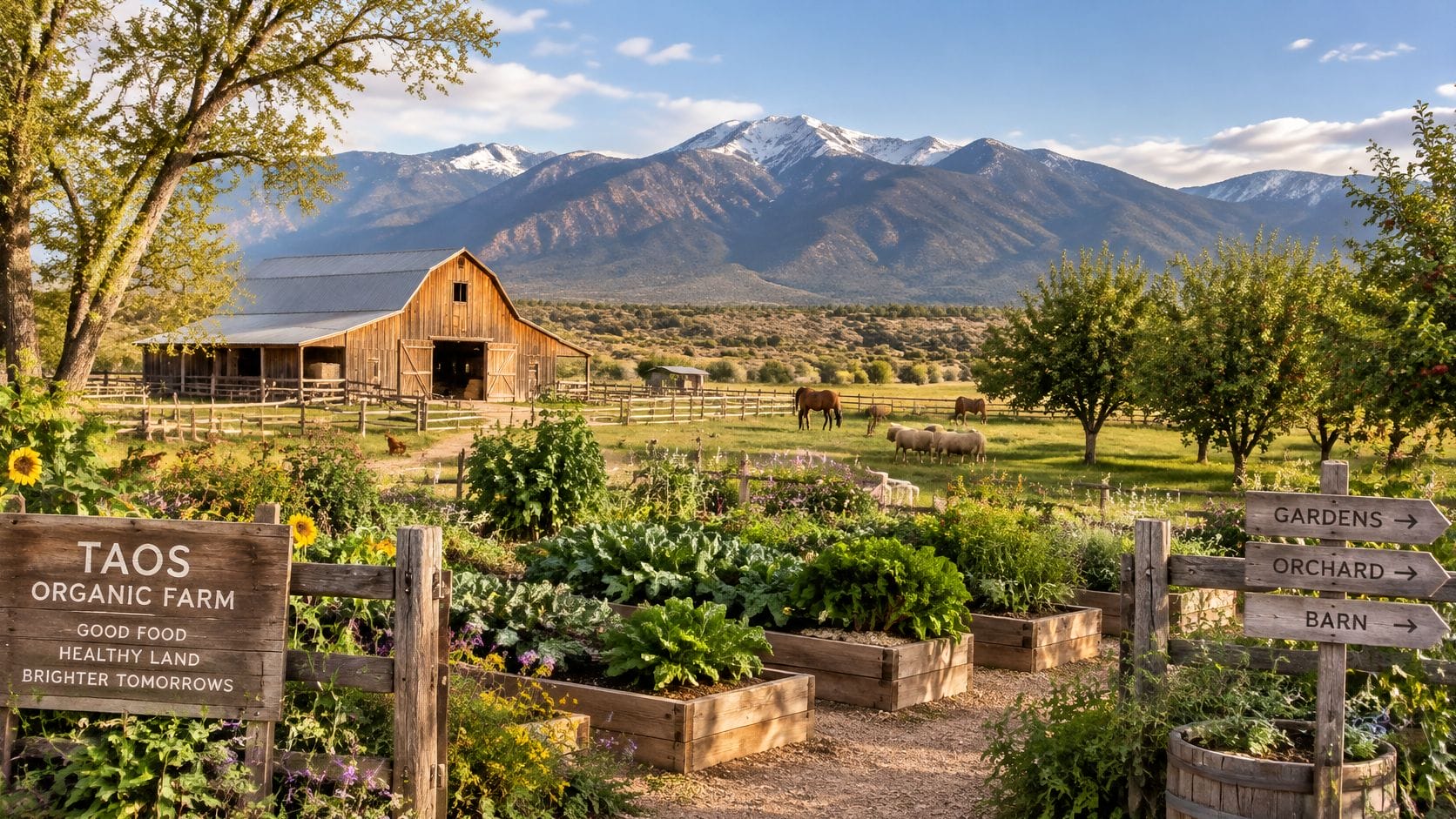
Treat Taos Goji as the test case for judging dependability alongside scenery. We're a 40-acre retreat property and working organic farm in San Cristobal, 11 miles north of Taos, with gardens, orchards, and fields. Historic cabins, casitas, glamping tipis, a rustic barn, and outdoor gathering spaces give planners one property where lodging and gathering can sit together.
The setting earns attention first. The fit still has to survive your schedule.
Match the farm setting to your gathering
A donkey, alpacas, and goats graze in the field near our historic cabins, which are named for the artists and writers who once stayed here. Mountain views and open skies frame the property, while gardens and outdoor areas give guests places to be together between programmed blocks. Our farm life overview offers context for that setting.
For a reunion, weigh whether the farm environment works across generations. For an artist retreat, decide how much unstructured time the group wants around sessions. For a memorial, prioritize privacy, comfortable seating, and an emotional pace that does not feel rushed.
We have infrared and wood-fired saunas, and wedding parties can use our Japanese hot tubs. Ask during planning which amenities apply to your booking instead of assuming access comes with every stay.
Request answers specific to your program
Send your proposed schedule and ask for written confirmation of the details that decide whether it works:
- Smoke-day operation: Which spaces could hold the gathering if outdoor time is limited, and what would change?
- Room suitability: Which indoor configuration fits the full group and the planned activity?
- Cold-weather comfort: How are the accommodation and gathering spaces heated?
- Connection requirements: What connectivity can be verified where your team will work?
- Changing conditions: Who communicates decisions, and how will guests receive updates?
- Accommodation allocation: Which units suit your guests, and what still needs outside arrangement?
An unanswered question is not a yes. A barn's character does not confirm heating or filtration, and lodging on the property does not confirm that your whole group can stay together on your dates.
Compare written answers, not impressions
Build a shortlist that fits your guest count, nights, and purpose. Send each venue the same program and questions, then compare inclusions, unresolved needs, cancellation terms, indoor alternatives, and outside arrangements in one shared document. Put smoke-day plans, connectivity, and applicable rules beside views and amenities so the prettier option does not win by default.
For travelers coming from Santa Fe, Albuquerque, neighboring states, or elsewhere in the Southwest, our location is San Cristobal, north of Taos. Plan the full arrival journey, including the last stretch to the property, before comparing venues.
Choose the property that suits the gathering without constant improvisation. Share your dates, group size, accommodation needs, and goals with us at taosgoji@gmail.com or 575.776.3971. For a wedding inquiry, ask for package details and a clear explanation of each inclusion.
For historic lodging, a working farm setting, and spaces for meaningful gatherings in Northern New Mexico, visit Taos Goji. Tell us whether you're planning a wedding, retreat, workshop, or quiet stay, and share the practical needs that will make the property right for your group.
Prepared with the Outrank tool