
Best Wedding Venues in Taos, New Mexico: A Planning Guide
Taos Pueblo is a living community that has been continuously inhabited for more than 1,000 years, according to the National Park Service. That depth of place makes a wedding here something different from a celebration built around scenery alone. Mountains, agricultural land, and living cultural traditions deserve thoughtful planning, not just a spot on the photography list.
The best wedding venues in Taos, New Mexico are the ones that suit your guests as well as your ceremony. A beautiful property still needs a workable weather backup, a lodging plan that fits your group, and a clear answer on permits and alcohol service. I weigh those logistics as heavily as the view, because they decide whether the day runs smoothly. Compare them before you fall in love with a mountainside.
Table of Contents
- Taos Wedding Venue Types at a Glance
- What a Historic Farm Wedding Venue Offers Guests
- Glamping Tipis, Cabins and Casitas for Wedding Guests
- Weather and Fire Planning for Mountain Ceremonies
- Marriage License Steps Before Your Taos Ceremony
- Alcohol Permits for Receptions Off Licensed Premises
- Visiting Taos Pueblo as a Guest
- Sequence Your Decisions and Send a Clear Inquiry
Taos Wedding Venue Types at a Glance
| Venue type | Best for | Weather exposure | Question to ask |
|---|---|---|---|
| Historic farm with barn and cabins | Couples wanting a farm setting with on-site lodging options | Open-sky ceremonies need a written rain plan | Which spaces are covered, and which cabins can our group reserve? |
| Mountain ranch or lodge | Larger groups seeking vows, dinner, and lodging on one property | Hillside and wind exposure | Is there a covered reception room and enough overnight accommodation? |
| High-desert outdoor site | Elopements and small ceremonies with minimal décor; book lodging separately unless confirmed | Full sun by day, cold after sunset | Is there power for portable heat? |
| Town venue or event hall | Guests who prefer nearby hotels and restaurants; verify walkable lodging | Indoor rooms can reduce exposure; confirm climate control | Which lodging is within walking distance? |
| Private garden or home setting | Small, flexible gatherings; overnight stays require explicit permission | Shelter requires an approved tent and power plan | Can a tent or heater be added? |
Match these categories to your guest count and ceremony style before comparing individual properties. Intimate elopements and micro weddings may suit a high-desert outdoor site, particularly when the celebration needs little equipment. Larger groups seeking lodging together should begin with historic farms or mountain ranches, then verify actual sleeping and reception capacity.
These are venue types, not guarantees of amenities. A barn isn't automatically a weatherproof reception room, and a lodge doesn't necessarily have enough bedrooms for every guest. The distinctions that matter most are on-site lodging, indoor backup space, and distance from the town of Taos.
Compare the whole celebration
According to The Wedding Report, Taos, New Mexico recorded 226 weddings in 2025. That's a sign of an active wedding market, not a prediction of availability, so contact shortlisted venues early in your planning year.
A town venue can simplify independent dining and hotel access. A rural property may give guests more time together, but transportation and overnight arrangements need closer attention. A private home can feel personal while requiring more rented infrastructure and explicit event permission.
Shortlist by function first: Keep the venue types that can support your guests comfortably, then compare atmosphere.
Choose a small shortlist of venue types. Give each the same lodging, weather, and permit questions, and treat any cultural excursion as a separate part of the itinerary.
What a Historic Farm Wedding Venue Offers Guests
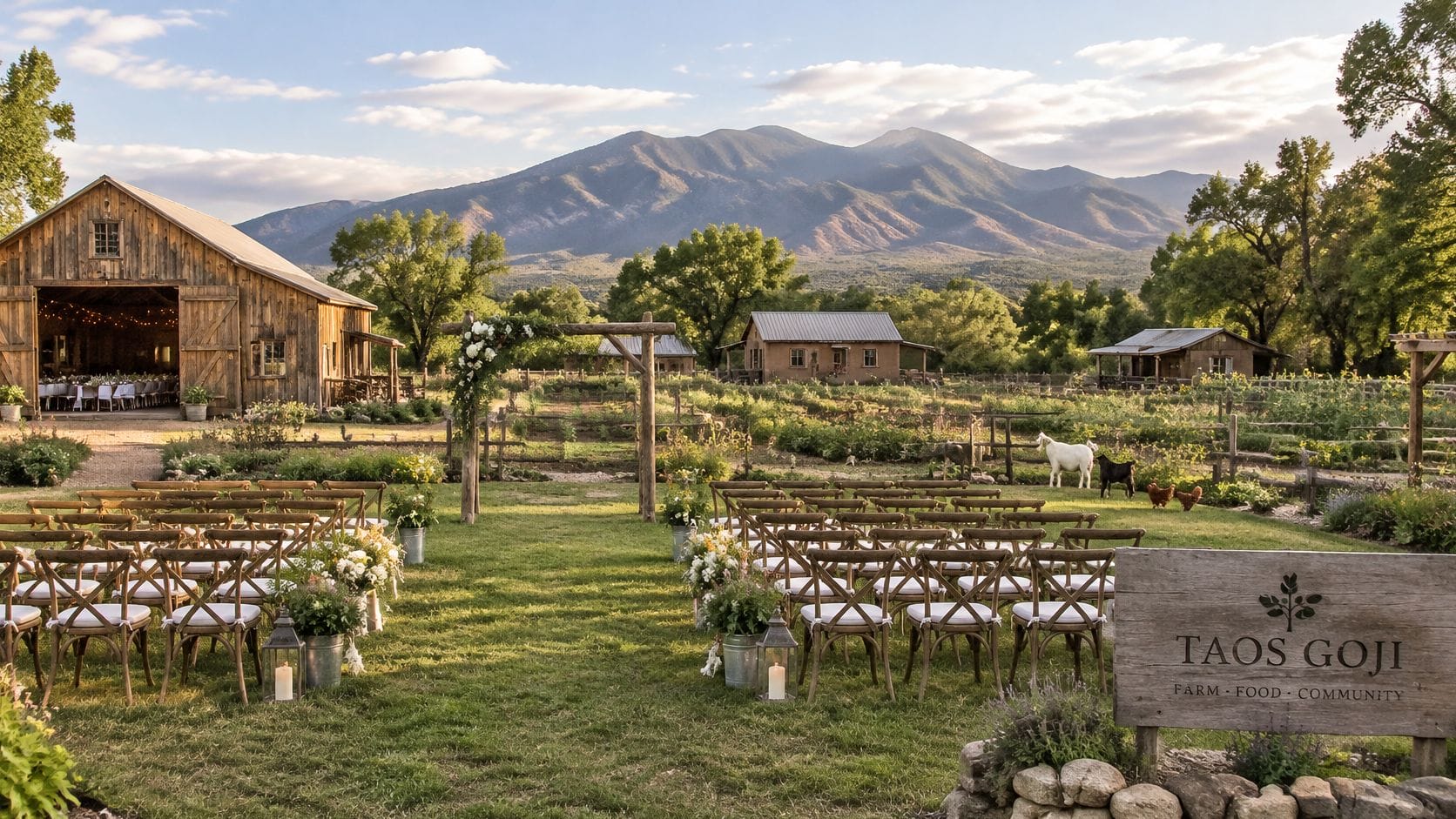
At Taos Goji, a historic farm and retreat property in San Cristobal, the setting includes more than a ceremony lawn. Our 40 acres, 11 miles north of Taos, contain a working organic farm with gardens, orchards, and fields. Mountain views frame the gathering spaces, while a rustic barn gives the property its agricultural character.
A donkey, alpacas, and goats graze in the field near our historic cabins. The cabins are named after the artists and writers who once stayed here, so overnight guests sleep inside the property's creative history rather than beside it. For couples drawn to northern New Mexico, those details can offer a sense of place without elaborate decoration.
Think beyond the ceremony
We host weddings ranging from an intimate elopement to a weekend-long celebration, and offer Rustic Farm & Barn wedding packages. Wedding parties can use our Japanese hot tubs, and the property's on-site amenities include infrared and wood-fired saunas. Shared features like these can support a slower gathering, but couples should establish how their planned activities fit the event arrangements.
A weekend celebration has moving parts a single afternoon does not. Say you're planning a welcome gathering, a ceremony, and a reception: walk through each transition separately, from where guests arrive and where they wait to where dinner is served and how vendors reach their working areas. A farm's appeal comes partly from its varied spaces, but moving between them should feel easy rather than improvised.
Explore our farm event options while deciding which parts of that setting matter to your celebration.
Ask what the farm setting requires
Use these checks for any historic farm venue:
- Covered spaces: Which location protects the ceremony if weather turns, and which can accommodate the reception with tables, service routes, and dancing?
- Barn inclusion: Is the barn included in the selected package, or is its use arranged separately?
- Farm operations: How are farm work, deliveries, and animal care scheduled around guest arrivals and event activities?
Add timing to that list. Ask how far ahead the venue confirms dates and which permissions your reception plans may trigger, since rural properties often involve arrangements a town venue handles for you.
Animals are part of a working property, not unattended entertainment. Keep guest circulation and photography plans compatible with their care, and avoid assuming every attractive field is an event area.
Write those questions down before making an inquiry. The answers help you distinguish a venue that looks rustic from one whose arrangements suit the celebration you're planning.
Glamping Tipis, Cabins and Casitas for Wedding Guests
A destination wedding turns lodging into a planning question in its own right. Guests traveling to the Taos area need somewhere to settle for a night or more, and where they sleep shapes how they experience the whole weekend, not just the hours between ceremony and reception.
Start with your actual guest list. Ask who wants an enclosed room, who enjoys sleeping closer to the outdoors, and who needs a particularly straightforward route between accommodation and gathering spaces. Don't assign accommodation solely by age or family relationship.
Match the stay to the guest
Historic cabins and casitas suit guests who prefer an enclosed room and some quiet away from the social energy of the celebration. At Taos Goji, each cabin is named after an artist or writer who once stayed there, which gives the rooming plan a story guests tend to remember. Glamping tipis appeal to guests who want the outdoor feel, provided the sleeping arrangements and nighttime conditions match their expectations.
Keeping guests on site removes a post-reception drive, and with the property 11 miles north of Taos, that drive is long enough to matter after dark. It doesn't remove the need to plan safe movement around the property or arrange transportation for anyone staying elsewhere.
Before reserving, review our glamping tipi accommodation and put the practical questions alongside the photographs:
- Sleeping arrangements: How many guests does each tipi sleep, and what bedding is provided?
- Overnight comfort: How is the tipi heated, and what temperatures should guests prepare for in colder months?
- Lighting: Are the paths between the tipi, restrooms, and event area illuminated?
- Restroom access: Where is the nearest restroom, and what is the walking route?
- Group reservations: Can several units be reserved together for the wedding party?
Build a rooming plan before booking
Create a simple rooming spreadsheet with guest names, preferred accommodation, arrival and departure dates, and any access needs. Separate confirmed requests from tentative interest so you don't reserve around assumptions.
For guests traveling through Santa Fe or Albuquerque, or driving from neighboring Southwestern states, clarify which night they expect to reach San Cristobal. Send the accommodation preferences with your event headcount so the venue can respond to the group you need to house, and ask early which combination of cabins, casitas and tipis it can hold for your dates.
Weather and Fire Planning for Mountain Ceremonies
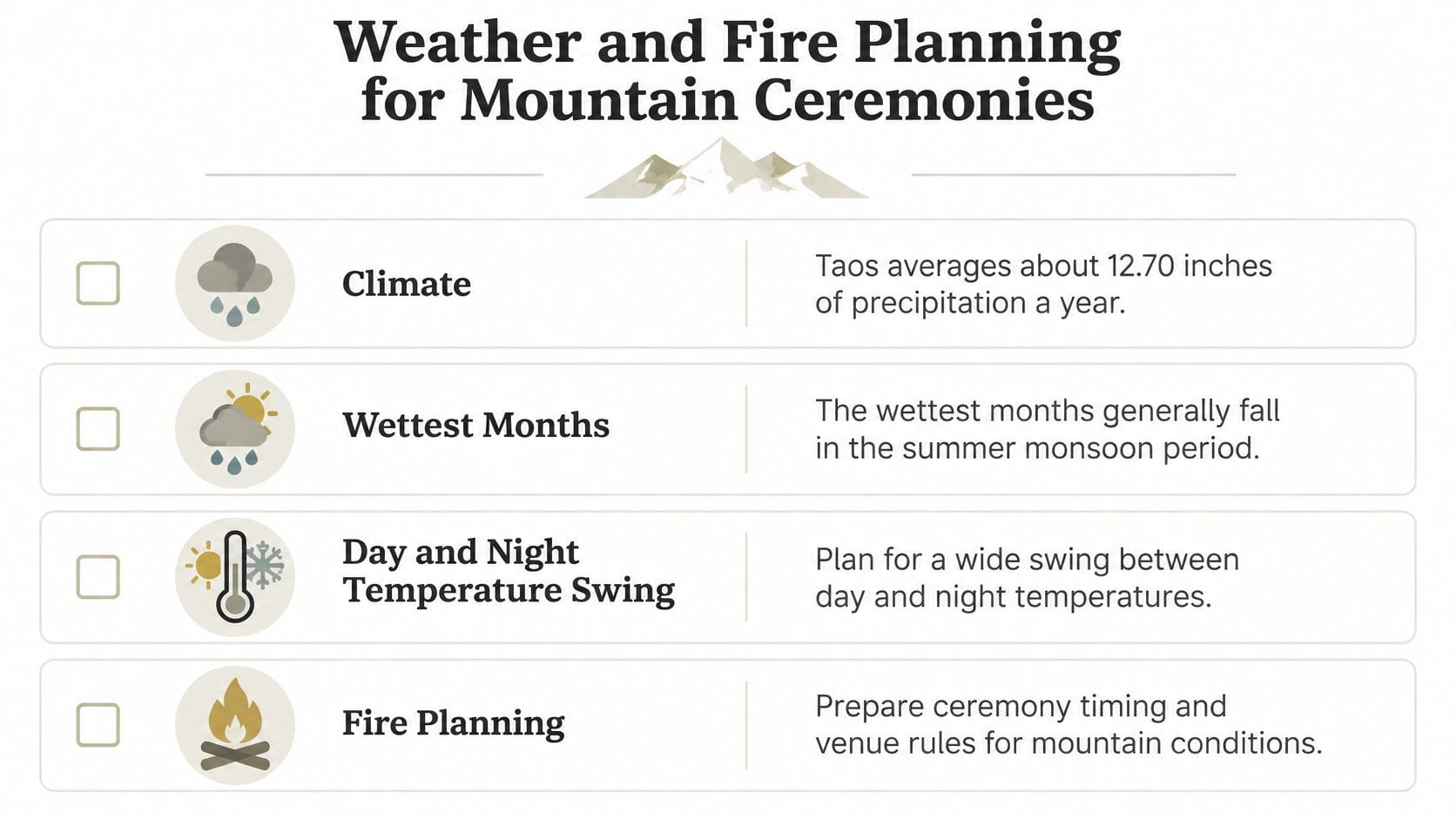
Taos averages approximately 12.70 inches of precipitation annually, with wetter conditions generally associated with the summer monsoon period and substantial day-to-night temperature variation, according to the Taos climate summary. A warm ceremony afternoon doesn't tell you whether guests will be comfortable at dinner. Plan for the reception's final hour, not only the moment you exchange vows.
Fire conditions need a separate conversation. Town of Taos public notices have warned about extremely dry conditions, wind, high fire danger, and restrictions affecting campfires, fireworks, and sky lanterns. Those notices aren't a standing permission or prohibition for your date, so establish who will check current restrictions and communicate changes.
| Risk | What to Request in Writing | Question to Ask |
|---|---|---|
| Rain, snow or wind | Covered rain location and tent policy | Where do guests move if the ceremony shifts indoors? |
| Dry conditions and burn ban | Rules for fire pits, candles, sparklers and lanterns | Which open-flame items are allowed on the date? |
| Temperature drop after sunset | Portable heat sized for the evening guest count | How many heaters are on site, and who sets them up? |
Use this checklist when reviewing a potential outdoor layout.
Walk the backup route
A credible backup plan identifies a covered location with usable capacity, not merely an empty building. Ask to see the arrangement with dinner tables, catering access, entertainment equipment, and guest circulation included. If a tent is proposed, establish its permitted placement and the installer's wind-response procedure.
Check hard-surface or reinforced access routes, weighted décor, and protected electrical distribution. Portable heaters need an approved location, suitable power or fuel arrangements, and a named person responsible for setup. Keep emergency vehicle access clear when placing rental equipment.
A scenic outdoor site is only as useful as the space guests can safely move into when conditions change.
Smoke can require a different response from rain, so ask what would trigger relocation, a delayed start, or cancellation. Confirm who makes that decision and how guests and vendors receive it.
Request the written weather-contingency layout and confirm the agreed arrangements in the contract before paying a deposit.
Marriage License Steps Before Your Taos Ceremony
| Requirement | Detail |
|---|---|
| Fee | $55, paid by cash or credit card |
| Applicant age | At least 18 years old |
| Photo identification | Government-issued, showing name and date of birth |
| Social Security | Card or number required |
| Non-U.S. citizens | Two valid forms of identification |
| Appearance | Both applicants in person |
| Office hours | Monday to Friday, 8:00 a.m. to 4:30 p.m. |
| Officiant | Not provided by the County Clerk |
| Expiration and return | License does not expire; completed document is returned to the County Clerk after all required parties sign |
These are the requirements published by the Taos County Clerk's marriage license office, including the $55 fee, minimum applicant age of 18, and weekday hours of 8:00 a.m. to 4:30 p.m. Confirm current office arrangements before traveling, particularly if your arrival falls near a holiday.
The application belongs on your travel itinerary, not in an informal reminder to handle paperwork when you arrive. Both applicants need to be available together, and your officiant requires a separate arrangement. A venue reservation doesn't complete either task.
Put the paperwork in order
- Coordinate attendance: Choose a weekday when both applicants can visit in person without conflicting with travel or event setup.
- Gather documents: Put the required identification and Social Security information in a secure travel folder. Non-U.S. applicants should check their documents against the clerk's instructions before departure.
- Visit the clerk: Allow room in the itinerary for the office visit rather than fitting it between appointments with no margin.
- Arrange the officiant: Confirm who will conduct the ceremony and discuss responsibility for completing the paperwork.
- Return the document: Assign responsibility for getting the signed license back to the County Clerk.
The lack of an expiration date can give couples flexibility to obtain the license ahead of the busiest part of their wedding trip. Don't confuse that flexibility with completion: the signed document still needs to be returned.
For a destination elopement, schedule the weekday visit early enough that administrative work isn't competing with the ceremony itself. Ideally, finish it before the concentrated run of wedding-week gatherings begins.
Alcohol Permits for Receptions Off Licensed Premises
| Item | What to Confirm |
|---|---|
| Town of Taos submission | To the Town Clerk, at least 12 days before the event |
| New Mexico ABC Division application | At least 10 days before the event |
| Town approval | Typically within three working days |
| Who files | The New Mexico license holder, not a private individual |
| Permit types | Special Dispenser Permit or Public Celebration Permit |
| Permit scope | Confirm coverage of ceremony, cocktail hour and reception areas |
| Caterer role | Confirm the caterer can legally pour |
The Town of Taos permit process specifies submission at least 12 days before the event to the town and at least 10 days before to the New Mexico Alcoholic Beverage Control Division, with town approval typically within three working days. It also states that the appropriate New Mexico license holder, not a private individual, applies for the Special Dispenser Permit or Public Celebration Permit when serving away from approved licensed premises.
These are the town's procedures. For a venue outside town boundaries, confirm the applicable local approval route with the license holder rather than assuming the Town Clerk handles the property.
Give each responsibility an owner
Build a short responsibility matrix with the venue and caterer. Name the licensee, identify whether the intended service location is approved licensed premises, and record who prepares and submits any application. Include someone responsible for checking that approval has arrived.
Then test the proposed bar operation against the floor plan. Can the caterer legally pour, or is another licensed operator needed? Who checks identification, and how will the service team manage access to alcohol?
Moving a bar from a garden to a barn during bad weather shouldn't introduce an unexamined service location. Ask whether the approved scope accommodates the planned ceremony, cocktail hour, reception, and backup arrangement.
Planning safeguard: A caterer's willingness to serve isn't the same as confirmation that the proposed alcohol service is authorized.
Count backward with room for corrections
Treat the filing deadline as a latest permissible submission point, not a sensible day to begin gathering information. Leave room for missing signatures, revised layouts, or questions from the reviewing authority.
Count backward from the reception date using the applicable town submission minimum where that process applies. Confirm the license holder, filing route, and service plan in writing with the venue before signing, so the bar isn't an unresolved condition attached to an otherwise suitable property.
Visiting Taos Pueblo as a Guest
Taos Pueblo is a living community, not a wedding backdrop. UNESCO records its World Heritage inscription in 1992, its National Historic Landmark designation in 1960, and its governance by an independent and autonomous Tribal Council, Governor, and War Chief. UNESCO also explains that the landmark designation requires federal agencies to consult with the Pueblo about projects that could affect the property.
A wedding booked nearby grants no permission to hold activities there. Cultural significance, public visiting access, and authorization for a ceremony or commercial photography are separate matters.
The National Park Service describes continuous occupation for more than 1,000 years and notes that access is generally available daily except for tribal ritual closures, including an approximately ten-week closure from late winter into early spring. Verify current conditions rather than treating that general pattern as a guaranteed visiting calendar.
Keep the excursion separate
Give guests a respectful plan:
- Check access: Confirm current visiting conditions before choosing the excursion date.
- Ask about photography: Establish what is allowed before bringing cameras or arranging professional photographs.
- Separate permissions: Never assume visitor admission permits a ceremony, engagement session, or commercial shoot.
- Leave itinerary space: Schedule the visit separately from venue activities, with enough flexibility to accept a closure.
- Follow local direction: Respect posted rules and instructions from the community.
Avoid presenting the visit as a guaranteed wedding-weekend attraction. Guests can appreciate the region without expecting access to every culturally important place on their preferred schedule.
Approached thoughtfully, the Pueblo can be a meaningful cultural excursion near a wedding venue. It should never be treated as an extension of that venue's event space.
Sequence Your Decisions and Send a Clear Inquiry
Choose in an order that reduces expensive changes. Begin with the venue type that fits your celebration, then assess whether its covered layout and accommodation arrangements work for the people attending. Styling decisions can follow once the event has a sound practical foundation.
For a broader planning calendar, EventUploader's a practical 12-month wedding timeline can help organize the surrounding tasks. Adapt it to a rural destination wedding by giving travel, lodging coordination, and vendor access their own deadlines.
Work backward from the date
Set the alcohol-service filing milestone with the responsible license holder before filling the calendar with decorative decisions. Schedule the marriage-license visit while both applicants are available, and arrange the officiant independently. Keep any Pueblo excursion separate from the contracted wedding program.
Then request a property-specific lodging allocation rather than a general statement that accommodation exists. A useful response identifies which cabins, casitas, or tipis could suit your group and what still needs confirmation.
Prepare an inquiry containing:
- Dates: Your preferred wedding date, alternatives, and intended arrival and departure days.
- Attendance: Ceremony and reception headcounts, including any different guest lists.
- Spaces: Your preferred ceremony and reception settings, plus the covered alternative you need.
- Lodging: The number of overnight guests and their accommodation preferences.
- Alcohol: Whether you intend to serve it and whether you've identified a licensed provider.
Ask for a concrete next step
Consider Taos Goji alongside the other venue types that meet your priorities, and explore our wedding package options before making an inquiry. We welcome questions about weddings, retreats, events, and stays by email at taosgoji@gmail.com or phone at 575.776.3971.
Ask us to confirm availability for the dates you have in mind. Accommodation reservations are made through our booking system and listing sites such as Airbnb and Hipcamp; coordinate the event inquiry before assuming separate lodging reservations establish wedding arrangements. Send your inquiry this week with your dates and headcount.
Our historic farm brings together mountain views, rustic gathering spaces, and overnight accommodation for celebrations with time to connect. Visit Taos Goji to explore the setting, then send your preferred dates, guest count, and lodging needs so we can discuss whether the property suits your wedding.