
Unique Wedding Venues New Mexico: How to Choose
Start with the view, the usual advice goes. But say you've found a ceremony site beneath a wide New Mexico sky, then discover that your grandmother needs a long drive back to her hotel, the musicians can't play there, and your reception requires another address. The photograph still works. The wedding needs more thought.
When you're comparing unique wedding venues in New Mexico, start with where people will sleep, gather, and go when the weather changes. A distinctive property earns its place on your shortlist when it makes those movements easier, not only when it looks unlike anywhere else.
Table of Contents
- Unique Venue Types Across New Mexico
- Private Acreage and Public Land Limits
- Marriage License and Alcohol Timing
- Match Celebration Shape to Cabins and Shared Space
- What to Confirm on a Mountain Farm
- Ask About a Mountain Farm Wedding
Unique Venue Types Across New Mexico
A landmark may set the scene, but the couple still has to fit the celebration around its rules. Say you're choosing between an adobe inn, a living-history farm, and a mountain property: the guest count, overnight plan, and limits on gatherings can matter as much as the view.
In 2025, New Mexico recorded 9,388 weddings, with estimated spending of $223,209,088, an average expenditure of $23,776, and a median of $15,043, according to New Mexico Magazine's overview of New Mexico wedding venues. The gap between average and median is a useful reminder that the average is not a spending target for every couple.
A property with lodging may reduce travel between the ceremony and overnight rooms, but it does not automatically cost less. Compare the full arrangement, including transportation, rentals, meals outside the reception, and any rooms needed elsewhere.
How unique New Mexico venue types compare
These are planning patterns, not promises about an individual property's capacity or services.
| Venue type | Guest pattern | Lodging | Main constraint | Best fit |
|---|---|---|---|---|
| Living-history farm | Gatherings subject to site approval | Plan for nearby lodging unless on-site rooms are confirmed | Preservation requirements, operating hours, and rural access | Couples drawn to agricultural heritage |
| Historic inn | Casas de Suenos accommodates approximately 101 to 150 guests | On-site rooms at the inn | An established inn layout rather than open acreage | Guests who want ceremony space and accommodations at one property |
| Private mountain farm | From an intimate elopement to a weekend-long celebration, within approved capacity | Cabins, casitas, or similar accommodations where offered | Weather, rural roads, and vendor travel | Multi-day gatherings with shared outdoor space |
| National park or monument | Small ceremonies within the site's permitted headcount | Arrange lodging separately from the ceremony site | Special-use permission, operating hours, sound, and equipment rules | Couples for whom the landmark itself is central |
| Hotel or banquet hall | Reception planned around confirmed room capacity | Hotel rooms or room blocks | Less connection to an agricultural setting | A single-day celebration with established catering arrangements |
South of Santa Fe, El Rancho de las Golondrinas is a large agricultural living-history site. Its historic character makes it distinct from an empty field, with cultural stewardship part of the setting.
Choose the overnight pattern first
Say your closest guests want breakfast together the morning after the wedding. An inn or lodging-based rural property may fit better than a ceremony-only location, even if the latter makes a stronger first impression.
For couples drawn to natural textures and less formal arrangements, Taos Goji's guide to boho wedding venues in New Mexico offers another way to consider the setting. Keep the practical question alongside the aesthetic one: which kind of venue suits the people who need to sleep on site?
Private Acreage and Public Land Limits
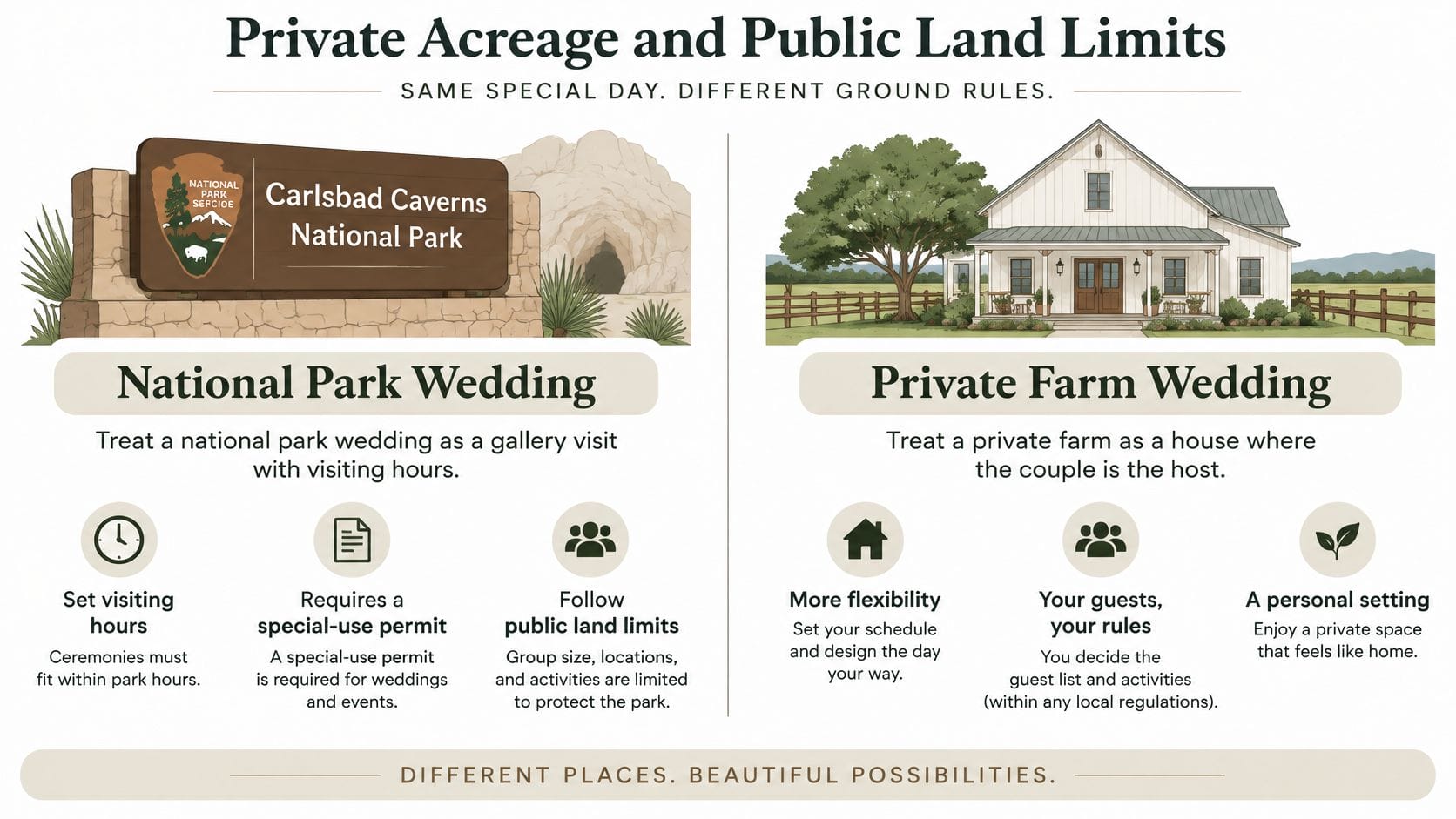
Treat a national park wedding like a gallery visit with visiting hours. You're entering a protected place whose purpose extends well beyond your celebration. A private farm is closer to a house where you're the host, although the owner still sets the boundaries.
The distinction is easiest to see when you compare the activities each place can accommodate.
What a landmark asks you to accept
Carlsbad Caverns National Park requires a special-use permit, caps wedding parties at 20 people, restricts music and props, and requires events during normal operating hours. Those conditions can suit a small ceremony centered on the caverns. They're a different proposition for a reception with dinner, dancing, and guests arriving on separate schedules.
Northern New Mexico has its own advance-planning requirements: Bandelier National Monument requires special-use permits for weddings and elopements, with applications received at least one month in advance. A small gathering doesn't remove the need to apply.
At White Sands National Park, the application must identify guest count and proposed equipment, including music, artificial flowers, candles, tents, awnings, and chairs; the park lists a $100 application fee and processes applications in the order received. Your seating and shelter choices belong in the application, not in a last-minute rental order.
Practical rule: Write down the part of the day you won't give up before falling in love with a location.
What private land can change
Say you want a quiet outdoor ceremony followed by a meal that continues after daylight fades. A private property may offer more control over that sequence, particularly when guests can walk back to their accommodations. But private ownership doesn't guarantee unrestricted sound, tent installation, or permission to move an event indoors.
Use these nonnegotiables to narrow the search:
- Sound: Is amplified music permitted, and where?
- Timing: Can the ceremony start when you want it to?
- Shelter: Is an approved weather alternative available?
- Overnight use: Can the people who matter most remain on the property?
For a visual sense of the rural setting, take a look before drawing up your site-visit questions.
Compare destination wedding venues in New Mexico by those permissions rather than by scenery alone. Drop a site if its rules exclude the gathering you want.
Marriage License and Alcohol Timing
Say you're traveling from another state and have arranged a tasting, a cabin stay, and a meeting with your officiant. Put the county-clerk visit on that same itinerary. Scenery doesn't file the paperwork, and a destination wedding needs a legal sequence as carefully considered as its guest arrivals.
Put the license before the ceremony
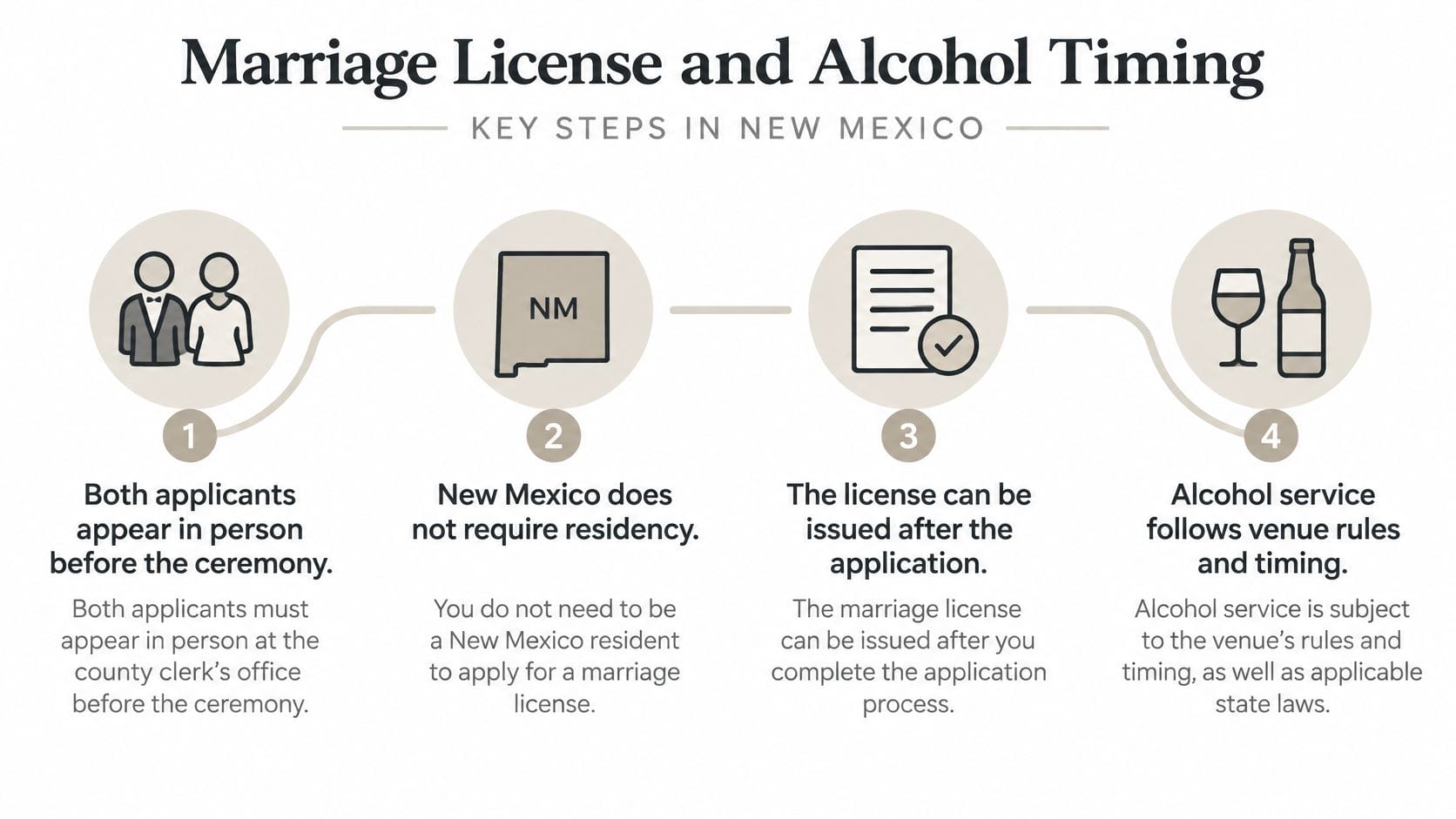
Choose the issuing county and arrange an in-person visit. Both applicants generally need to appear, and Santa Fe County's marriage-license guidance is a useful starting point for understanding the application process. Confirm office hours and appointment procedures with the clerk you'll use.
Prepare that county's identification and payment requirements. Bernalillo County requires both applicants to appear with two current government-issued forms of identification each and a $25 fee; neither applicant needs to be a New Mexico or county resident, and witnesses aren't required to receive the license. Don't assume another county uses precisely the same counter procedures.
Have the license in hand before the wedding, then assign responsibility for returning it. Chaves County states that the license can be used anywhere in New Mexico and that the signed document must return to the issuing county clerk within 90 days of the ceremony. Confirm who will complete the document, obtain the necessary signatures, and handle delivery.
Keep the application and ceremony responsibilities separate. Not needing witnesses at the clerk's counter doesn't answer every question about completing the marriage certificate.
This visual can help you keep the administrative tasks beside the celebration plans.
Set the beverage plan before the welcome party
Alcohol service away from an already licensed premises requires more thought than assigning someone to buy drinks. Under the New Mexico Alcoholic Beverage Control Special Dispenser Permit framework, only a qualifying dispenser-license holder can obtain the permit, not the couple, and the licensee needs written permission from the property owner.
The framework lists $25 per day for a private event and $50 per day for a public event, with standard authorization limited to 12 hours per day and three days. Those are permit charges, not a quotation for beverage service.
Ask the licensed provider to coordinate the floor plan, licensed servers, local-option requirements, and submission schedule. If you're planning welcome drinks and a farewell brunch, put each service period into that discussion rather than treating everything around the reception as informal.
A weekend invitation isn't blanket authorization for alcohol service throughout the stay.
Match Celebration Shape to Cabins and Shared Space
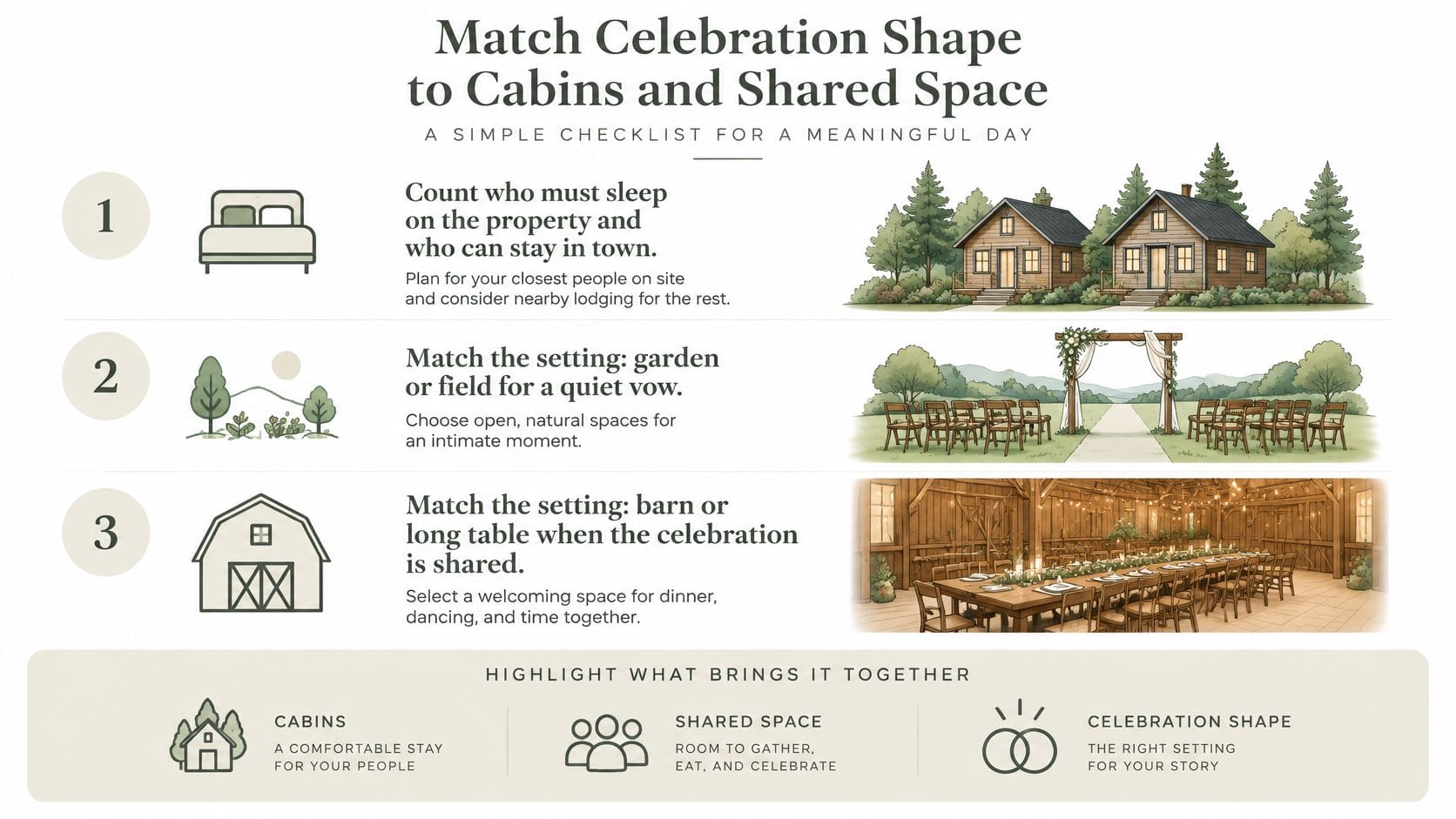
Begin with names rather than a venue capacity. Put the guests who need overnight accommodations in one column and those comfortable staying in town in another. Include the relative who shouldn't drive after dark, the friend traveling with children, and anyone who needs a particularly easy route between bed and breakfast.
Then sketch an ordinary morning, not just the ceremony. Where does someone make coffee? Where do early risers sit without waking the wedding party? Where can people gather without entering another guest's bedroom?
Make these checks before assigning rooms
Count essential overnight guests first. A bed inventory isn't the same as a rooming plan. Couples, children, unrelated adults, and guests needing privacy may use the same inventory quite differently.
Match the setting to the central activity. A garden or field may suit quiet vows. If the meal is the heart of the gathering, prioritize the table arrangement, service access, lighting, and shelter instead of giving all your attention to the ceremony arch.
Identify shared space that isn't a bedroom. Ask which room can support breakfast, conversation, or a change of weather. Confirm whether it remains available when vendors are preparing the reception.
Test the arrival route. Review the approach from Taos and the longer journeys from Santa Fe or Albuquerque. Ask about the final road surface, seasonal conditions, unloading, and where a driver can turn around.
Use this checklist while reviewing a property map and proposed room assignments.
Group size, lodging, and shared space
The smaller ranges below are hypothetical planning scenarios, not industry definitions or statements of any property's capacity. For scale, The Wedding Report's New Mexico market figures place typical statewide weddings at approximately 88 to 98 guests.
| Gathering | Who sleeps where | Shared space | Access to plan |
|---|---|---|---|
| Elopement, a planning example of 2 to 10 | One cabin or casita if its approved occupancy fits | A small outdoor vow spot | A simple arrival plan with confirmed parking |
| Micro wedding, a planning example of 11 to 30 | Several cabins for the inner circle, subject to occupancy | One shared table, barn, or garden | Carpools on rural roads |
| Intimate party, a planning example of 31 to 60 | A mix of on-site rooms and town lodging | Ceremony lawn plus a sheltered reception | Transportation between the property and town |
| Typical statewide size | Mostly off-site hotels if on-site beds are insufficient | A larger reception footprint | Confirm capacity before booking |
| Weekend retreat wedding | Overnight beds for the core party across meals | A gathering room used more than once | Coordinated arrival and departure windows |
Follow the day through an actual example
For an elopement, the appeal may be the absence of a tightly managed schedule. You arrive, settle into your accommodation, exchange vows, and leave room for a walk or an unhurried meal. The practical test is whether the approved ceremony location and weather alternative support that simplicity.
A micro wedding asks a different question: can everyone sit comfortably at the same meal? A beautiful outdoor table won't solve a catering-access problem, and a cabin suitable for sleeping may not be approved for hosting the whole gathering. Make the sheltered meal arrangement part of the initial proposal.
With a larger intimate party, separate the rooming list from the reception plan. Guests staying in town still need arrival instructions, a place to leave coats, accessible facilities, and a clear way home. Avoid letting the people with off-site rooms become an afterthought.
A useful distinction: Choose an elopement for solitude, a shared meal for closeness, and a weekend when time together is the point.
Our guide to New Mexico wedding venues with on-site lodging can help you evaluate accommodations alongside gathering space. Read lodging descriptions with the same care you give ceremony photographs: the right room arrangement can matter more than another decorative feature.
For a weekend, leave space between hosted activities. Guests don't need a program for every waking hour, and the couple shouldn't become the breakfast coordinator, transportation dispatcher, and reception host at once.
What to Confirm on a Mountain Farm
Send a proposed day, not merely a date. A useful inquiry describes arrivals, the ceremony, the meal, music, overnight guests, and departure. The owner can then respond to the gathering you intend rather than to an undefined request for a wedding venue.
Ask questions that produce usable answers
Which spaces can hold this particular guest list? Request approved ceremony and reception capacities separately. Ask whether vendors, musicians, and service staff affect the practical layout.
Where does the gathering move in bad weather? Name the activities that need shelter, including waiting, dining, and any music. Ask who decides to change locations and when rental equipment must be committed.
How will guests and vendors arrive? Request directions suited to rural access, after-dark arrivals, deliveries, and seasonal road conditions. Provide transport providers the exact destination instead of just telling them the wedding is near Taos.
What belongs to the overnight reservation? Ask for the accommodation inventory, approved occupancies, shared-room access, and any spaces reserved separately. Establish where breakfast happens before assigning every available room.
Who coordinates beverage authorization? Identify the licensed provider and the person handling property-owner permission. Put the service locations and hours into the event documents before finalizing the beverage agreement.
Which permissions should appear in writing? Confirm sound, chairs, tent installation, vendor access, cleanup, and departure expectations. A friendly conversation is valuable, but it shouldn't be the only record of an important arrangement.
Prepare people as carefully as the site
Mountain-wedding guidance should include clothing, not just directions. California Cowboy's resource on elegant outfits for chilly ceremonies can help guests think about layers without abandoning the occasion's dress. Pair that guidance with plain advice about footwear for grass or uneven ground.
For elders and guests with limited mobility, ask about the actual walking route. A short distance can still include loose gravel, a threshold, or an unlit section that needs attention. Describe those conditions in the guest information rather than relying on a broad assurance that the setting is rustic.
Choose the property whose written answers fit your guests, not the photograph you'd most like to reproduce.
At our San Cristobal location, the useful starting point is a clear description of your gathering. Keep the questions concrete enough that the reply can become a working plan rather than another round of general inspiration.
Ask About a Mountain Farm Wedding
A venue can look memorable in a photograph and still leave a couple juggling permits, lodging, and separate gathering spaces. A private mountain farm may bring more of the celebration together on one property. It suits couples who want guests to stay and gather in the same setting; a large, fully serviced ballroom reception calls for a different fit.
Taos Goji is a 40-acre historic farm and retreat property in San Cristobal, 11 miles north of Taos, New Mexico. Its destination wedding setting brings together mountains, open skies, historic cabins and casitas, and Rustic Farm & Barn wedding packages.
Bring a proposal that reflects your priorities
Say a couple is weighing an intimate elopement against a weekend-long celebration. The shape of the gathering affects who may stay on the property and how guests will use its spaces. Taos Goji hosts weddings ranging from elopements to weekend-long celebrations, alongside retreats, events, and stays.
Start your inquiry with the details that will shape the gathering:
- Overnight list: Who hopes to stay on the property, and who will need to stay elsewhere?
- Celebration rhythm: Are you considering an elopement or a weekend-long gathering?
- Beverage plans: Which gatherings would include alcohol, and will you engage a licensed provider?
- Accommodation needs: What mobility, privacy, or family arrangements should be considered?
The farm's gardens, orchards, and fields sit alongside its gathering spaces. Donkeys, alpacas, and goats graze near the historic cabins, which are named for artists and writers who once stayed there. The property's history as a gathering place for artists, writers, and visionaries gives its setting another layer, but the practical questions still come first.
Taos Goji welcomes inquiries about weddings, retreats, events, and stays. Send proposed dates and your gathering details to taosgoji@gmail.com or call 575.776.3971. An inquiry starts a conversation about whether the property's lodging and gathering spaces fit the celebration you have in mind.
A mountain farm wedding can make the stay part of the gathering. Visit Taos Goji to explore the property, then share your overnight plans, celebration style, and beverage intentions.