
Best Corporate Retreat Venues in New Mexico for 2026
You've narrowed the search to New Mexico, and the photographs are making every option look plausible. A mountain backdrop would suit the team, the cabins look inviting, and someone has already suggested moving the strategy session outdoors. What you still don't know is whether everyone can sleep comfortably, join the program fully, and get online when the presenter needs them to.
The best corporate retreat venues in New Mexico aren't interchangeable. A rural retreat farm, a town hotel, and a conference campus solve different problems. For a northern New Mexico offsite, I'd choose the setting only after checking the details that can undermine an otherwise thoughtful program: winter access, connectivity, accessibility, and approved occupancy.
Table of Contents
- Quick Picks for Corporate Retreat Venues in New Mexico
- Single-Site Retreat Farms Near Taos and What Taos Goji Offers
- Glamping Tipis and Cabins to Confirm Before Booking
- Taos Meeting Scale and Outdoor Breakout Space
- Winter Access and Connectivity Before You Sign
- Accessibility and Inclusion Checks for Mixed Teams
- Fire Safety and Group Size Requirements
- Confirm the Venue Checklist Before You Book
Quick Picks for Corporate Retreat Venues in New Mexico
| Venue type | Best-fit group | Lodging on site | Meeting and outdoor space | Verify first |
|---|---|---|---|---|
| Single-site retreat farm near Taos | Teams wanting sleeping, meetings, and downtime on one property | Cabins, casitas, and glamping tipis | Gathering spaces and open land on 40 acres | Group bed count and tipi heating |
| Taos hotels, inns, and campuses | Town-wide conferences up to 750 attendees | Hotel rooms and inn beds | 74,000 square feet of meeting facilities across the Taos area | Room block size and transfer time |
| Bed-and-breakfasts, guest houses, and inns | Smaller leadership meetings | Guest rooms | Confirm a private meeting room and usable outdoor areas | Meeting room availability |
| Outdoor breakout settings in the Taos area | Field sessions and nature-based programs | Paired with lodging elsewhere | 1,444,480 acres of surrounding wilderness | Weather plan and indoor backup |
Read this comparison as a set of fit questions, not a ranking: which setting supports the work this group needs to do? The Taos-area meeting and wilderness figures describe the wider destination, not the capacity or bookable grounds of an individual property.
Match the setting to the assignment
A retreat farm is worth considering when the purpose is sustained conversation, creative work, or a quieter leadership gathering. A hotel or campus deserves closer attention when procurement needs a substantial room block, concurrent sessions, and a more formal production setup. Neither format automatically provides exclusive use, accessible bedrooms, or dependable hybrid-meeting infrastructure.
For a small leadership team, a guest house or inn may be enough, provided there's a private workspace rather than just a communal breakfast room. An outdoor setting is better treated as a program component than as a substitute for a working base. Someone still needs to arrange transport, permissions, bathrooms, and a usable fallback.
Before approaching properties, put the retreat's purpose into a short written brief. MyPerfectStay's business retreat planning guide is a useful companion for organizing that conversation, particularly when colleagues have different expectations about work time and downtime.
For teams arriving through Albuquerque or considering Santa Fe alongside Taos, separate the arrival city from the retreat location. Compare the complete journey and program, not just the venue photographs. Work through the decision in order: setting, lodging, meeting scale, logistics, then the final checklist.
Single-Site Retreat Farms Near Taos and What Taos Goji Offers
For a corporate retreat, one property can keep lodging, gathering spaces, and shared meals within the same setting. That reduces the need to organize transfers between separate venues, though it does not guarantee exclusive use or fit every group's schedule.
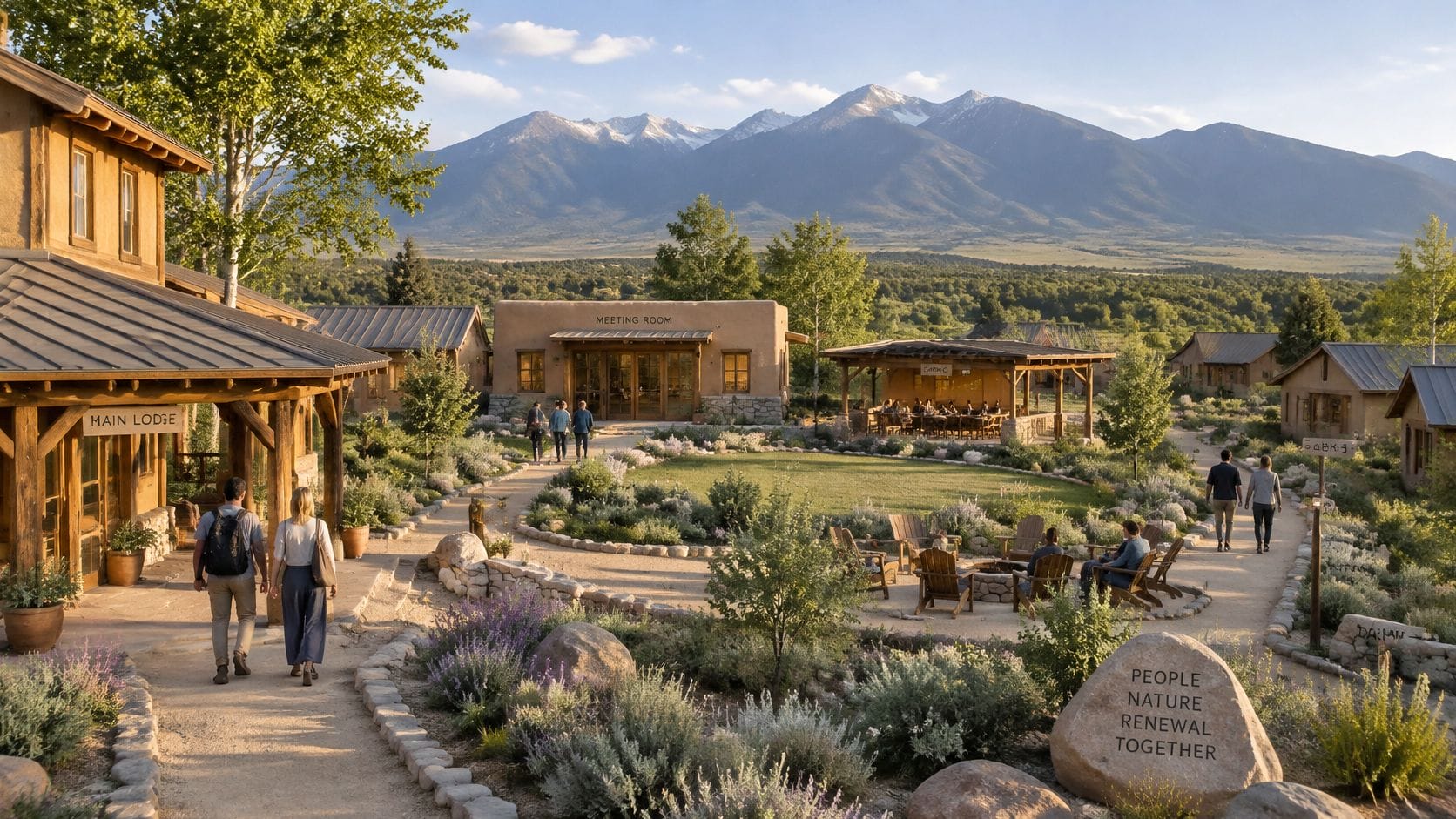
Taos Goji is a 40-acre retreat center in the mountains of Northern New Mexico, with lodging, gathering spaces, and room to slow down. It is a working organic farm with gardens, orchards, and fields. Historic cabins, casitas, and a barn give the property a rural character rather than a conventional conference-hotel setup.
What the farm setting changes
Taos Goji is in San Cristobal, 11 miles north of Taos. The rural location offers a quieter base, while restaurants, shops, and town services require a drive. On-site lodging can keep participants together, but teams should still confirm whether other guests may be on the property and arrange transport for off-site plans.
A donkey, alpacas, and goats graze in the field near the historic cabins. The farm's daily activity is part of the setting, so confirm which outdoor areas are available for scheduled sessions. Taos Goji's history as a gathering place for artists and writers may also suit creative workshops or reflective leadership work. Its artist retreat information describes that side of the property.
Questions that turn atmosphere into a plan
- Meals: How will meals be arranged, served, and timed around the agenda?
- Town access: What transport should participants arrange if they plan to leave the property?
- Farm activity: Could work on the land affect the timing or location of outdoor sessions?
- Breakout use: Which grounds and gathering areas can the group use, and what indoor alternatives are available?
Planning judgement: A rural setting works best when the group plans to spend substantial time on site, rather than making repeated trips elsewhere.
Include the proposed schedule with your inquiry. It gives the venue a practical basis for discussing how the gathering spaces and lodging fit the retreat.
Glamping Tipis and Cabins to Confirm Before Booking
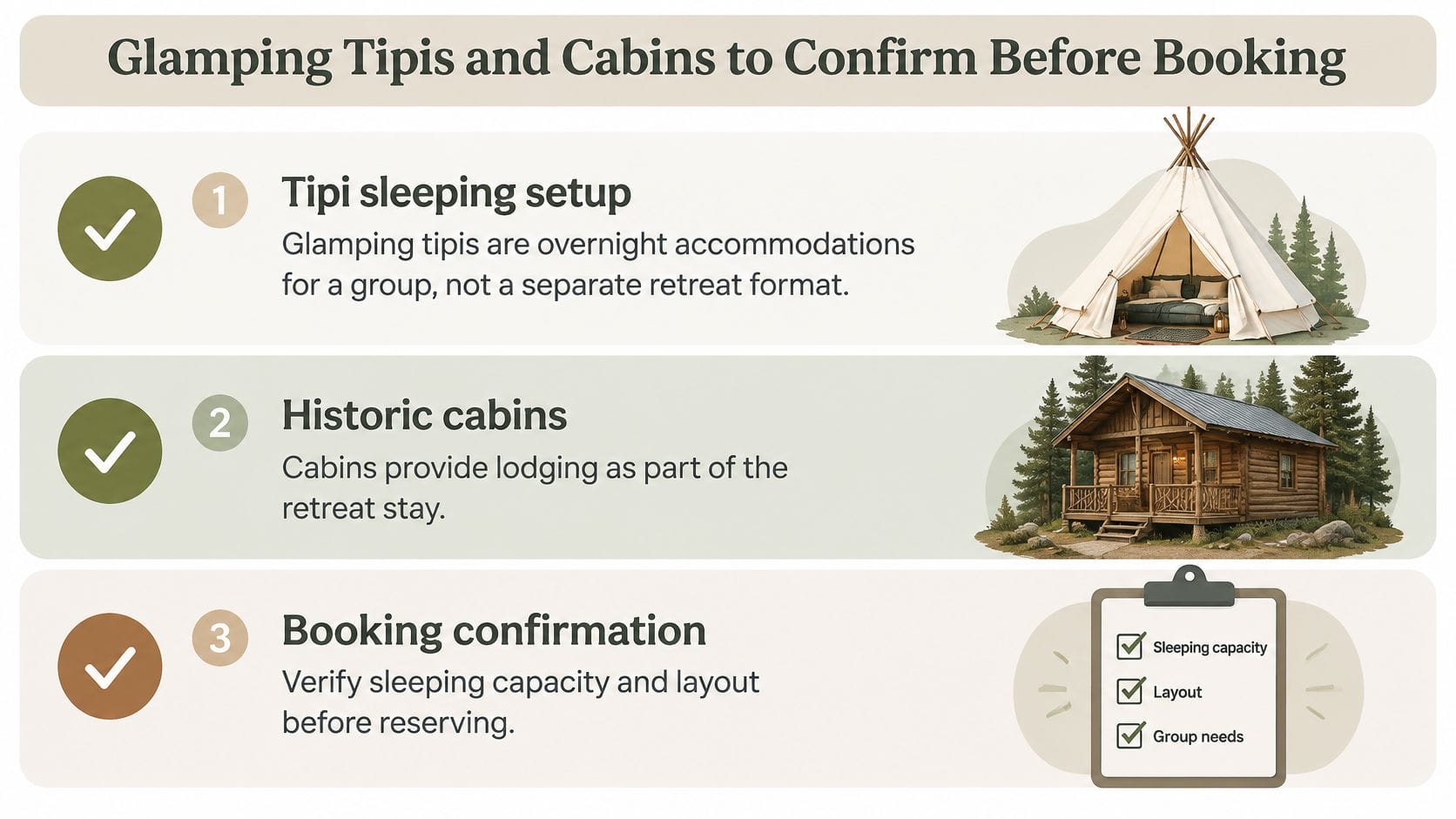
A glamping tipi is a lodging choice, not a separate retreat format. It belongs in the sleeping plan alongside cabins and casitas, with its own questions about comfort, access, and suitability. Don't assign it as a team-building exercise before asking whether participants want that experience.
Our overnight accommodations include glamping tipis, historic cabins, and casitas. The cabins and casitas offer quiet stays through the seasons, and our cabins are named after artists and writers who once stayed here.
Establish the sleeping setup first
Start with the glamping tipi information, then request the details needed for your dates. Treat each of these as a question, not a promised feature:
- Capacity and bedding: How many guests can each tipi sleep, and what beds, bedding, and heating are provided?
- Bathrooms and water: Where are they relative to the tipis and meeting areas, and what's the route like after dark?
- Shared-space expectations: How do quiet hours and shared facilities work?
- Mobility: Which lodging options and routes suit participants with limited mobility?
- Group inventory: How many units can be held together for the proposed stay?
A participant who welcomes a night under open skies may choose a tipi. Someone who needs fixed walls, a particular bed arrangement, or greater separation from outdoor sound may prefer a cabin or casita. Confirm the actual configuration before deciding either option meets a specific need.
Assign rooms privately, then reserve
Collect lodging preferences through a private form rather than a public team discussion. Ask about necessary sleeping arrangements and bathroom access without asking employees to disclose medical information to colleagues.
Our reservations run through our booking system and listing sites such as Airbnb and Hipcamp. Confirm whether the group's accommodation can be held through a single channel, who controls changes, and how individual reservations relate to the event agreement. Don't assume that reserving a meeting space also reserves every bed.
Finalize the lodging inventory first, match participants to suitable units next, and resolve any overflow before signing a contract. A room plan that works only if everyone accepts the same sleeping arrangement isn't finished.
Taos Meeting Scale and Outdoor Breakout Space
How many people must work together in the same room? That's a more useful opening question than total acreage or the number of attractive gathering spots. A property can offer generous outdoor space without having the indoor configuration your plenary session needs.
The Taos destination organization reports 74,000 square feet of meeting facilities across the area, identifies 1,444,480 acres of surrounding wilderness as potential outdoor breakout space, and describes town-wide conferences accommodating up to 750 attendees through larger hotels, inns, and campuses. It also identifies bed-and-breakfast lodgings, guest houses, and inns as options for smaller gatherings.
Count working configurations, not just guests
Use this sequence when comparing proposals:
- Count the people who must share a room. Include facilitators, presenters, and support staff, then specify the seating layout.
- Map simultaneous breakouts. A private discussion needs separation from the next group, not another table nearby.
- Establish overnight demand. Distinguish participants who need beds on site from those arriving only for daytime sessions.
- Match the setting. Compare the resulting room, breakout, and lodging requirements with the property's confirmed inventory.
For example, a focused leadership offsite may need a compact workspace and somewhere quiet to walk between discussions. A company-wide meeting may need hotel blocks, production support, and coordinated transport. A farm property is a candidate when the group's requirements fit its documented lodging and gathering spaces, not merely because it falls between those formats in atmosphere.
Wilderness acreage describes the destination's setting. It doesn't establish permission, accessibility, or readiness for a corporate session.
For field programming, check land access, guide arrangements where appropriate, and the practical route back to the working base. Larger programs can bring more transfers and coordination; a smaller, well-matched setting can offer greater privacy and continuity.
Winter Access and Connectivity Before You Sign
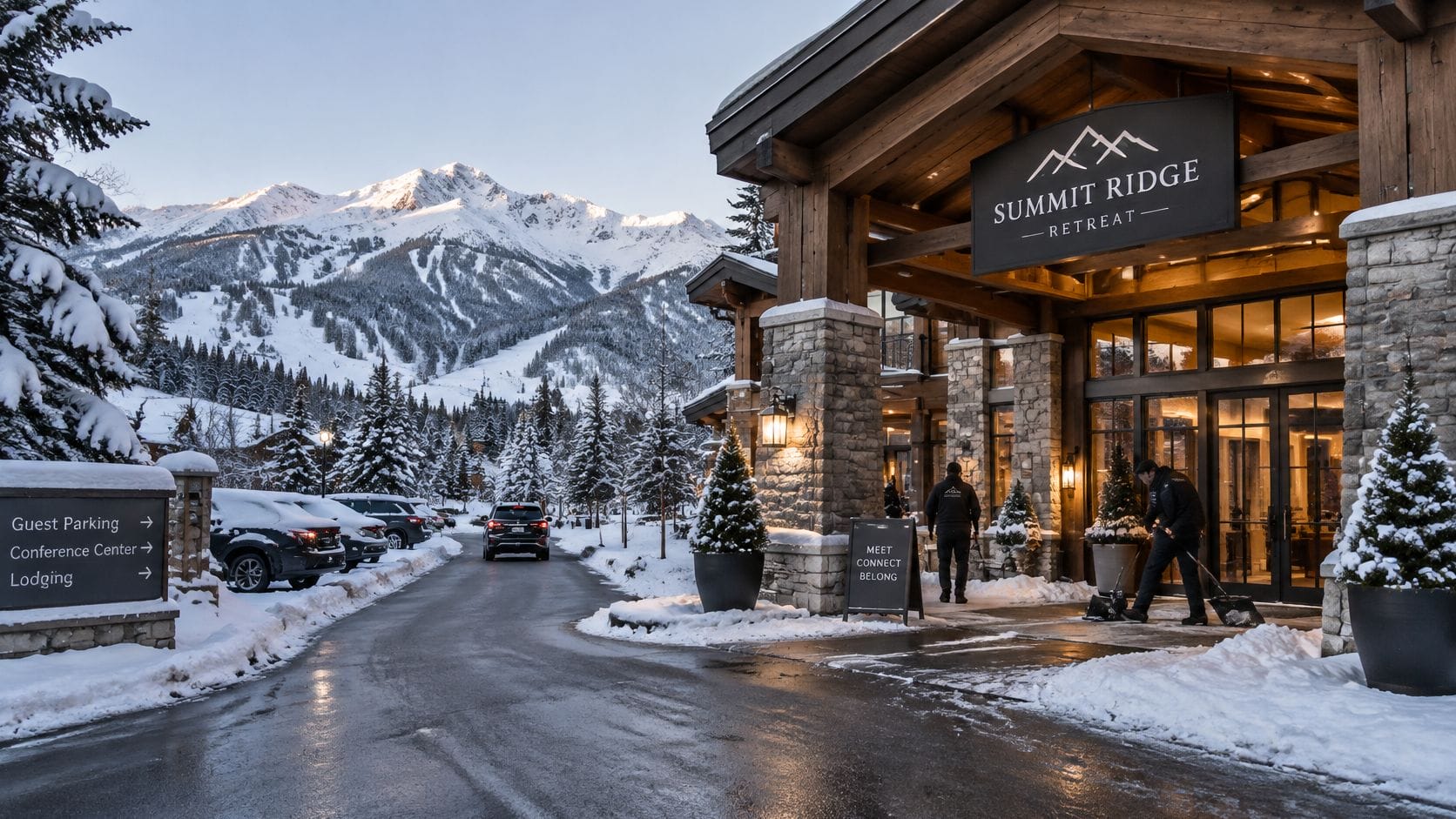
A mountain venue can support a winter retreat only if the approach, heating, backup power, and meeting setup work in poor conditions. Statewide broadband planning documents can provide context about rural connectivity, but they cannot confirm service at a specific property.
Ask for named responsibilities and documented capabilities. A general assurance that the venue stays open does not explain how it will handle a storm or a service outage.
Verify the physical operation
Start with the road approach, parking, and pedestrian routes. Ask who clears snow, which areas they maintain, and how arriving drivers receive updates.
Request a room-by-room heating plan, including the response if the primary system fails. Find out which equipment backup power supports. A generator may keep essential lighting on without running every bedroom, kitchen appliance, and presentation device.
Check that the indoor fallback can accommodate the planned outdoor session in its working layout. Bringing everyone under a roof is not enough if people cannot hear, see, or participate. Before committing travel expenditure, get the cancellation, delayed-arrival, and relocation procedures in writing.
Test the connection the program will use
Use statewide broadband planning documents for context, then verify the connection at the property. Request measured upload and download performance, latency, a Wi-Fi coverage map, and the outage-response procedure.
Have the IT lead test guest rooms, meeting rooms, and intended outdoor work areas under conditions that reflect expected occupancy. Ask whether bandwidth is dedicated or shared, whether presenters can connect by wire, and what cellular backup is available. The connectivity guide for remote rural workers can help frame questions about rural service without implying that a particular connection is guaranteed.
Keep the work portable: Save core materials offline and give the facilitator an agenda version that doesn't depend on a live cloud document.
On a lodging-plus-meeting property, one interruption can affect both accommodation and the program. Agree on a response before arrival, rather than improvising during a multi-day retreat.
Accessibility and Inclusion Checks for Mixed Teams
A venue comparison isn't complete if it tells you about the views but not the route from a bedroom to the meeting room. Employees who can't hike, tolerate smoke, or share rustic accommodation shouldn't discover those limitations after arrival. Documented access is part of venue selection, not a special arrangement to address after booking.
The Retreats and Venues budget guide recommends wheelchair accessibility and inclusion across races, creeds, and religions. For procurement, the useful next step is to translate that principle into specifications the venue can answer.
Request an access matrix
Ask the property to respond against the spaces your group will use:
- Routes: Surface, slope, steps, thresholds, lighting, and the connection between lodging and sessions.
- Rooms and bathrooms: Sleeping-room layouts, bathroom specifications, and privacy arrangements in shared buildings.
- Sensory needs: A quiet room, controllable sound and lighting, and information about possible smoke exposure.
- Transport and meals: Suitable transport for guests with limited mobility, dietary handling, and arrangements for religious observance.
Request photographs or a walkthrough where written descriptions leave uncertainty. Terms such as rustic or easy access don't tell a participant whether a route is suitable.
Build participation into the agenda
An activity being available doesn't make it broadly participatory. A trail walk may appeal to part of the group, but the alternative shouldn't be sitting alone while everyone else has the substantive conversation.
Pair outdoor programming with a seated or indoor option that has comparable purpose. If participants are discussing priorities during a walk, give the indoor group the same prompts and bring both groups' conclusions into the next session. Keep essential decisions in sessions everyone can attend.
Ask for a sample inclusive agenda and the per-person cost of each adaptation before comparing total proposals. Collect individual needs privately through HR or the designated planning lead, then share only the operational information the venue requires.
A smaller rural property can outperform a conventional hotel on privacy and flexible programming. That advantage is meaningful only when the property documents its access conditions clearly and the organizer designs a program people can join.
Fire Safety and Group Size Requirements
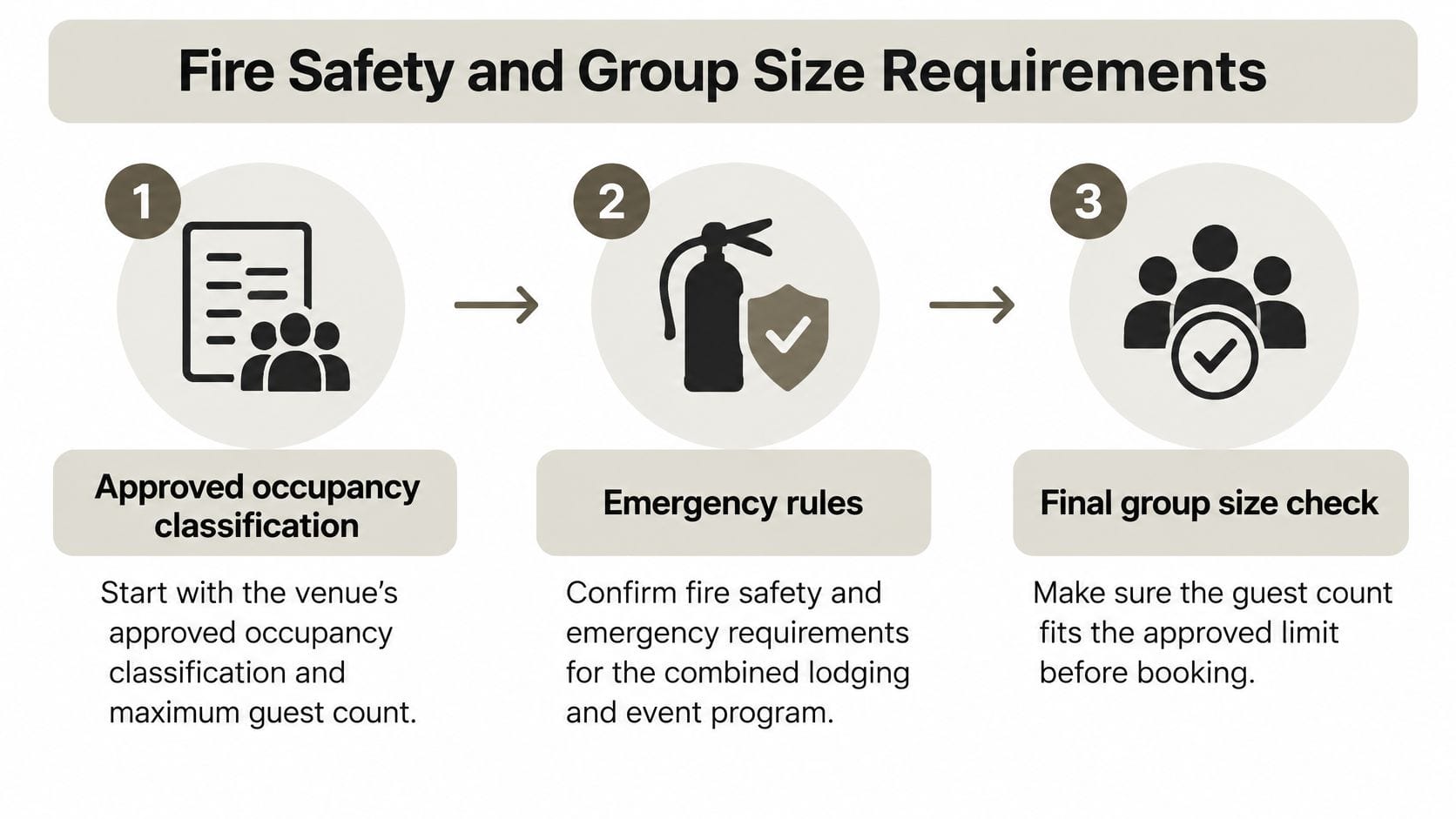
A combined lodging and event program needs more than a guest estimate. Begin with the venue's approved occupancy classification and maximum guest count. New Mexico's fire-protection and life-safety rules establish the regulatory context for public occupancies, making these checks relevant to the buildings your group will use.
Put emergency responsibilities in writing
Request the approved plan. For Group A occupancies, New Mexico's adopted fire-code emergency-planning provisions require an approved fire-safety and evacuation plan maintained at the facility; the provisions also address hotel and motel sleeping-unit evacuation diagrams and specify at least two trained crowd managers, plus one for every 250 attendees or portion thereof. Ask management to establish which requirements apply to your event and document the resulting plan.
Check sleeping-unit evacuation information. Ask for evacuation-route diagrams at or beside required egress doors where applicable to the accommodation classification. Participants need to understand their lodging exits, not just the route out of the meeting space.
Name the emergency contact. Confirm who handles emergencies on site and how that person is reached after hours. Include a procedure for contacting emergency services if cellular reception is unreliable.
Resolve crowd-manager staffing. Have venue management confirm the applicable staffing requirement for the expected attendance and event arrangement. Record who supplies the trained personnel rather than assuming the facilitator fills that role.
Verify each meeting-room limit. Request the maximum approved occupancy and confirm that the proposed seating, equipment, and catering layout preserve required exits. Don't use sleeping capacity as a substitute for meeting capacity.
Include outdoor sessions. Ask how staff will communicate an evacuation or relocation instruction when groups are dispersed. Confirm the assembly location and how the organizer will account for attendees.
Retain the documentation
An emergency can involve sleeping and gathering areas at the same time. Give participants clear arrival information and keep the approved plans, contact arrangements, and staffing confirmation in the contract file, not in a verbal assurance.
Confirm the Venue Checklist Before You Book
Before signing, identify what the venue can confirm in writing, what remains open, and who will resolve each question. An unanswered item may be workable, but it should not be treated as settled.
Use this checklist alongside the proposal. Assign each item to the person responsible for confirming it, and keep the final record with the planning team.
| Check | What to request | Why it matters | Confirm with |
|---|---|---|---|
| Fire safety plan | The applicable fire-safety and evacuation information for the facility | Clarifies the venue's procedures for the proposed gathering | Venue management |
| Crowd managers | Written confirmation of staffing for the expected headcount and event arrangement | Establishes who is responsible for crowd-management coverage | Venue management |
| Winter access | Road-access arrangements and who handles snow removal | Snow and ice can affect arrival timing and access | Venue operations |
| Backup power and heating | Details of available backup power and heating arrangements | Helps assess what can continue during cold-weather disruptions | Venue operations |
| Connectivity | Measured upload and download speeds, Wi-Fi coverage, and backup arrangements | Helps determine whether hybrid sessions and file transfers are workable | IT lead |
| Accessibility | Accessible routes, bathroom and sleeping-room details, quiet-room options, and transport arrangements | Helps assess what participants need to take part | HR and program lead |
| Lodging format | Beds and bathroom access by accommodation type, plus group-booking terms | Supports room assignments and privacy planning | Booking contact |
Send a brief the property can answer
Before contacting the property, gather your dates, headcount, preferred lodging mix, accessibility requirements, and a draft schedule. Flag sessions that need privacy, remote participation, or a shared room. Separate firm requirements from details the group can adjust.
Ask directly about meal arrangements, dietary needs, and meal timing for the proposed stay. Confirm what the property can accommodate and what the group must arrange separately.
Compare proposals by assigning responsibility for transport, accommodation, meals, staffing, and any required adaptations. A rural lodging-and-gathering property can keep a group in one place, but it may require more coordination than a town hotel. Choose based on confirmed fit with the agenda, not scenery alone.
Taos Goji welcomes inquiries about weddings, retreats, events, and stays. Email taosgoji@gmail.com or call 575.776.3971 with your dates, headcount, and program outline, then confirm which arrangements suit your group.
Taos Goji is a 40-acre retreat center in the mountains of Northern New Mexico, with lodging and gathering spaces. Explore Taos Goji and contact the property to discuss whether its setting and facilities fit your plans.
Composed with Outrank tool