
Best Outdoor Wedding Venues in New Mexico: What to Check
In the most recently reported statewide figures, 8,520 couples married in New Mexico and generated more than $205 million in total wedding expenditures, with a reported average wedding cost of $24,176 and an average guest count of approximately 100, according to the New Mexico Magazine wedding venues guide. That budget is why I don't rank the best outdoor wedding venues in New Mexico by the prettiest ridge. Couples compare packages, lodging, catering, and rentals closely, and a photograph can't tell you whether the hillside that frames the vows also sets the walking distance, the shade, the power, and the fire rules.
Northern mountain communities near Taos and Santa Fe give you high-desert land with cultural and historic character. A property that holds the ceremony, the gathering, and the overnight stay can cover several pieces of one wedding at once. The shortlist should start with documents, not a mood board.
Table of Contents
- What to Check Before You Shortlist an Outdoor Venue
- Space Needed for Ceremony, Dinner and Dancing
- Getting Every Guest From Parking to Pavilion
- Lodging, Facilities and Power on Site
- Seasons That Suit Outdoor Ceremonies
- Fire Rules, Permits and Open Flames
- Wildfire, Smoke and Your Backup Plan
- Confirm the Details Before You Inquire
What to Check Before You Shortlist an Outdoor Venue
Score every outdoor site against the same six rows. A ballroom hides its logistics inside four walls. Outdoors, the scenery is the logistics.
| Requirement | Question to Answer | Document to Request |
|---|---|---|
| Capacity | Does one site hold ceremony, dinner, dancing, and a rain plan for your guest count? | Scaled layout with square footage for each area |
| Facilities | Are restrooms, power, water, and kitchen access enough for your schedule? | Written list of facilities and where each one is located |
| Access | Can every guest reach each area without barriers? | Accessibility map showing surfaces, slopes, and drop-off points |
| Layout | Do the ceremony, dining, lodging, and parking zones connect on foot? | Site plan with walking distances between zones |
| Fire and permits | Which open flames, generators, and temporary structures need approval? | Fire-rules summary and permit list |
| Weather shelter | Is there covered space if wind or rain arrives? | Written decision deadline and backup room agreement |
Capacity is the first filter. A beautiful field can still be too small once chairs, a dinner layout, a dance area, and a covered backup all need ground. Ask for a scaled layout with square footage for each area, not a brochure acreage.
Facilities means a written list of restrooms, power, water, and kitchen access, each with a location. If the kitchen is a caterer's tent at the far edge of the property, your service timeline changes before the menu does.
Access and layout are different questions. Access asks whether every guest can move without barriers. Layout asks whether ceremony, dining, lodging, and parking connect on foot, and how long those walks are.
Practical rule: If a venue can't produce the document for a row, that row is a no, however strong the photographs look.
Fire and permits should arrive as a fire-rules summary and a permit list before anyone talks about candles or a generator. Weather shelter should arrive as a written decision deadline plus a backup room agreement, not a verbal promise to figure it out.
On our 40-acre farm in San Cristobal, ceremony areas, outdoor gathering spaces, and overnight stays share one property. That combination is worth scoring anywhere in northern New Mexico. It doesn't replace the six documents. I would not put Taos Goji, or any other site, on a shortlist until those pages are in hand.
Space Needed for Ceremony, Dinner and Dancing
Planners use three baselines before they believe a capacity number. Allow about 10 square feet per guest for ceremony seating, about 15 square feet per guest for a seated dinner including aisles and service paths, and 3 to 4 square feet per guest for a dance floor. These are rules of thumb, not a venue's specifications.
| Guests | Dance floor (3 to 4 sq ft each) |
|---|---|
| 50 | 150 to 200 sq ft |
| 100 | 300 to 400 sq ft |
| 150 | 450 to 600 sq ft |
A 100-guest walk-through
Say you're hosting about 100 guests. Ceremony seating needs roughly 1,000 square feet. A seated dinner needs roughly 1,500 square feet once aisles and server paths are in the count. The dance floor needs 300 to 400 square feet. None of that includes the band, the bar, the restroom queue, or a rain-backup room.
Add the zones before you trust the plan. Ceremony, dinner, and dancing alone already ask for something near 2,800 to 2,900 square feet of usable ground, and the support zones sit on top of that. Compare the sum with the usable area the venue reports. If the sum is larger, the day will feel crowded even when the property is vast.
A large acreage figure is not usable floor space. Flat, shaded ground is what you can actually set.
Ask for usable square footage by zone. A hillside farm can hold gardens, orchards, and views and still offer only a few level pads for chairs. I would rather see a smaller number that is flat and shaded than a romantic acreage that forces dinner onto a slope.
Also check whether the rain plan occupies the same pad as the ceremony. If the backup room is the dinner space, you can't count those square feet twice.
Getting Every Guest From Parking to Pavilion
A scenic venue is not an accessible one. Technical guidance for temporary outdoor assembly, in the Delaware event-planning accessibility guide, recommends accessible routes, level-ground shelters, accessible restrooms and drinking water, consistent wayfinding, and at least one accessible shelter in each major activity area when a large event can't rely on nearby buildings.
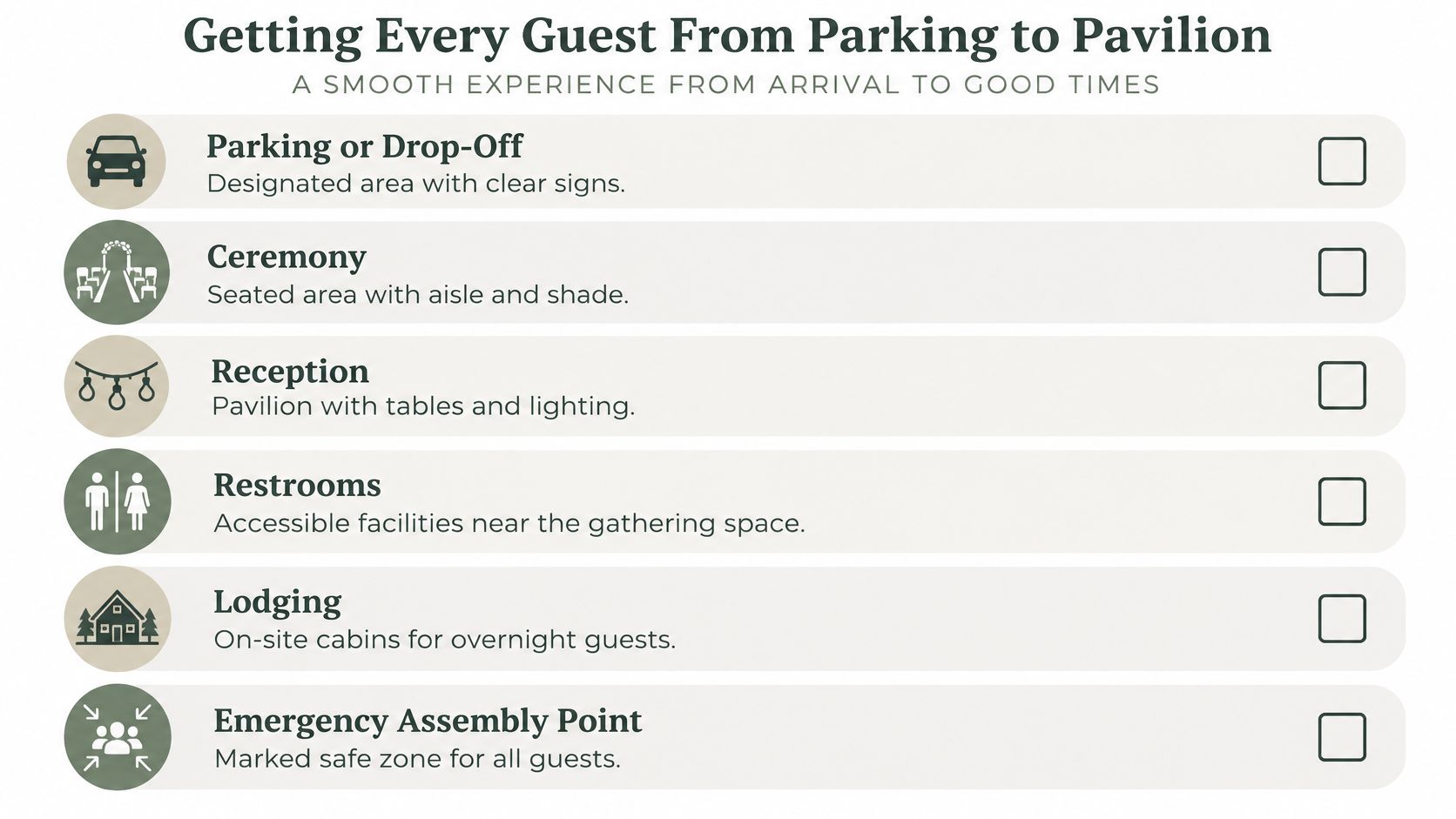
The guest journey is one chain: parking or drop-off, ceremony, reception, restrooms, lodging, and the emergency assembly point. A site can look ideal in photographs and still cost a great deal in access, through shuttle transfers, temporary flooring, ramps, or portable accessible toilets.
Walk the route before you sign
- Walk it with a mobility device. Time each leg from parking or drop-off through ceremony, reception, restrooms, lodging, and the emergency assembly point.
- Hunt for barriers. Check slopes, gravel, mud, stairs, and tent thresholds. A pretty gravel path fails a wheelchair and a guest on crutches the same afternoon.
- Mark pause points. Identify shaded resting spots and confirm a mobility device can wait under cover.
- Place water and restrooms. Confirm accessible restrooms and drinking water relative to the reception, not only relative to the parking lot.
- Replay the route in bad weather. Ask how it changes after rain or as evening temperatures fall, and whether lighting is installed.
Our place sits 11 miles north of Taos, so the drive is part of the plan. Ask about drop-off points and whether a shuttle is required before the date is held. The same check helps older guests and anyone with a temporary limitation, and it improves evacuation flow for the whole group.
Request a written route map showing surfaces and distances. If that map doesn't exist, the word "accessible" on a listing is only a label.
Lodging, Facilities and Power on Site
A weekend runs smoother when guests sleep where they celebrate. Nobody shuttles between a hotel in town and a ceremony site in the hills, and the morning-after breakfast happens on the same land as the vows.
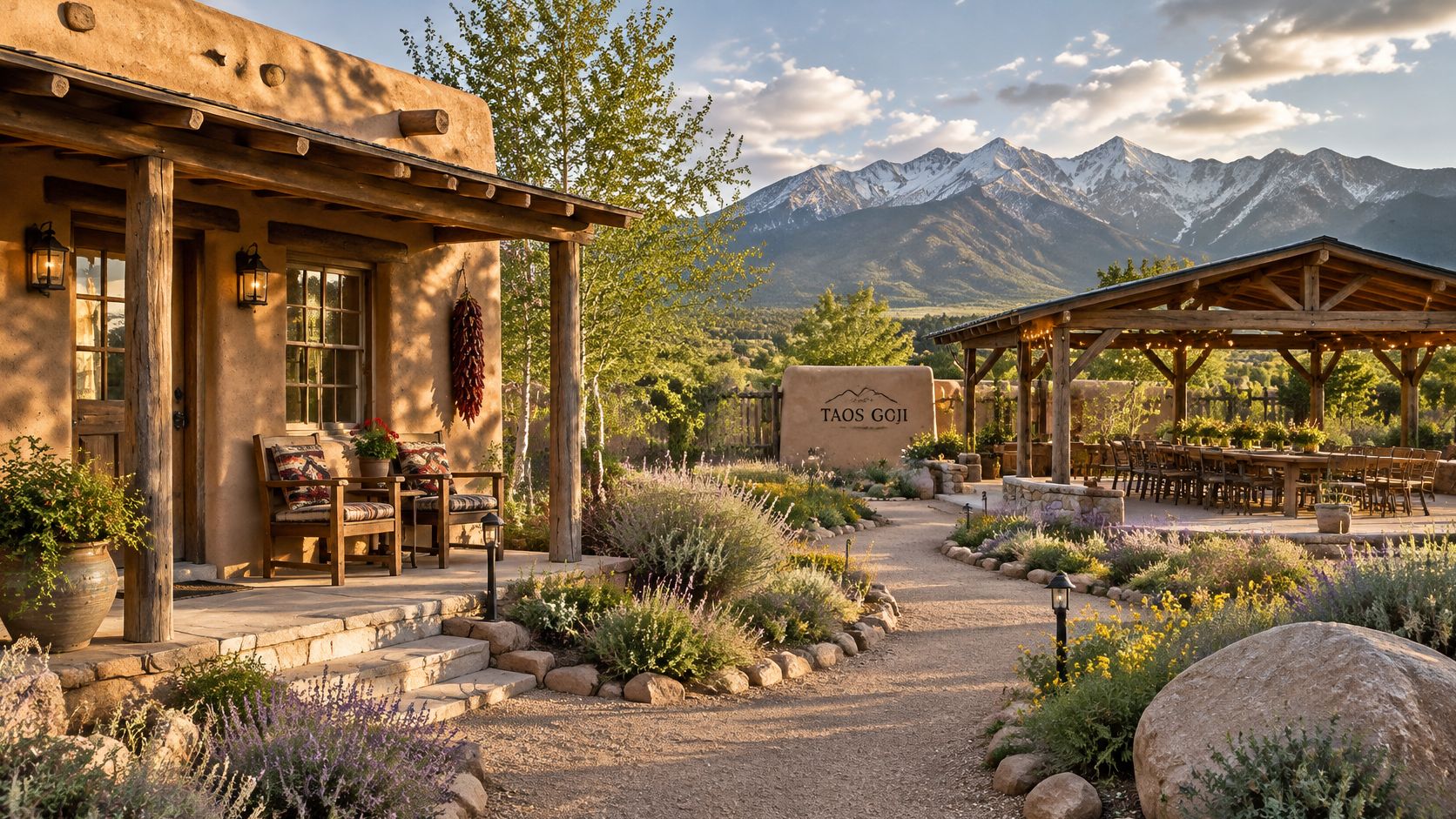
At Taos Goji, historic cabins and casitas sit on the same 40-acre farm as the gathering spaces. Our page on wedding venues in New Mexico with on-site lodging describes that setup. Taos Goji offers Rustic Farm & Barn wedding packages, so ask the team which spaces each package includes. Wedding parties can use the Japanese hot tubs, and infrared and wood-fired saunas are on the property. Confirm capacity and use terms for every space in writing rather than reading them off a photograph.
Questions to ask on any tour
- Overnight count: How many guests can stay, and is that lodging on the same property as the ceremony?
- Power: Is there power for a band, lighting, and a caterer's equipment, and which generators are permitted?
- Restrooms: Where do they sit relative to dinner, and how many are there?
- What you rent: Which items are included, and which you must bring, such as tents, generators, portable toilets, or extra tables?
The gap between what is on site and what you hire belongs in the budget. Tents, generators, portable toilets, and extra tables are the usual surprises on rural land, and each one carries a delivery fee and a setup window. Ask which of those are provided for your date and which you will rent, then get the answer on the contract.
A short walk through the buildings and the mountain backdrop is here:
Match that view to the written facilities list before you treat any building as dinner space, shelter, or lodging. A video shows the setting. Only the paperwork shows what you are paying for.
Seasons That Suit Outdoor Ceremonies
The right month is the one whose backup plan you can afford. Northern New Mexico elevation and mountain geography can produce different conditions from Albuquerque-area normals, so statewide climate tables are only a starting point. Ask each venue how its own site has behaved in past seasons, including wind on exposed ridges and where water runs during a hard storm.
Late spring and early autumn are usually easier to manage than midsummer heat or winter cold. Treat midsummer as a storm season: covered space should be part of the booking, not an upgrade added later. Treat winter as a daylight and temperature question, where the ceremony hour matters more than the prettiest month on a chart.
Turn the month into a deadline
A July date needs covered space reserved from the start. A February date needs temperatures checked during the ceremony hours, not just the afternoon high. Then do three things:
- Set a decision deadline for moving the ceremony under cover.
- Reserve the tent or backup room for that date in writing.
- Watch the forecast from the National Weather Service during the final week.
Open skies are an asset. They are a choice only when the rain, wind, and temperature plan is explicit. Couples comparing open-air settings, including the properties covered in our notes on boho wedding venues in New Mexico, should ask for that plan in the same conversation as the styling notes.
Fire Rules, Permits and Open Flames
Fire safety is a permitting question first and a décor question second. The Santa Fe Fire Department publishes fire-code guidance stating that special events are reviewed case by case under the 2021 International Fire Code, the 2021 International Building Code, applicable NFPA standards, and local ordinances. The same candle plan can draw different requirements from one county to the next.
A site plan may need to identify exits, extinguishers, fire lanes, hydrants, fire-department connections, and no-smoking signage. The local fire authority sets the required clearances for each of these, so ask the venue which standard applies to its address and who signs off on the layout.
Open flames face the most scrutiny. Candles, fire pits, fireworks, outdoor cooking, and generators can all fall under restrictions that tighten when wildfire danger is high, and high winds, low humidity, dry fuels, and red-flag conditions are the factors a venue should be tracking.
Where open burning is allowed, Santa Fe County's approach illustrates what responsible practice looks like even outside that county: parties verify restrictions before each burn, keep extinguishing equipment on hand, and maintain clearance between any burning and structures or combustible materials. Ask your venue what clearance its fire authority requires and who enforces it on the day.
Four approvals to get in writing
- Request a scaled site plan showing emergency vehicle access and evacuation routes, because a fire lane that looks open in dry weather can be blocked by guest cars.
- Pin the equipment. Ask where tents, cooking equipment, generators, and overnight-guest areas will sit so nothing lands inside a clearance zone.
- Require a written policy for candles, fire pits, and fireworks, including approved extinguishing equipment.
- Agree on a weather-based stop rule before the date, so a red-flag afternoon has an owner and a time, not a debate.
Before you compare properties, look at how unique wedding venues in New Mexico are framed, then ask each site for the same fire packet. A fire pit without that packet is an uninsured risk.
Wildfire, Smoke and Your Backup Plan
New Mexico authorities reported 366 wildfires during the first four months of 2026, twice the number recorded during the same period in 2025, and described statewide drought and severe fire conditions, according to the Lieutenant Governor's office. Federal drought guidance explains that dry grasses and trees become more flammable and that drought can increase both ignition probability and fire-spread rates.
Most venue lists still stop at a rain backup. They rarely say whether a property monitors fire restrictions, can relocate a ceremony during a smoke event, or has an evacuation procedure. Scenic remoteness in mountain and high-desert settings can increase that exposure.
What to compare on a tour
- Shaded and enclosed alternatives to the open ceremony ground.
- Air-quality communication, including who tells guests if smoke builds during the afternoon.
- Fire-safe catering and décor rules that stay legal if restrictions tighten.
- Cancellation or postponement terms written into the contract.
- Emergency vehicle access that stays clear of guest parking.
Ask two questions out loud. Can guests move indoors on a smoky afternoon? What happens to the event if fire restrictions tighten after the contract is signed?
I would rather choose the property with the transparent contingency plan than the most dramatic setting. The stronger site is the one that can keep guests safe without canceling the whole day.
Confirm the Details Before You Inquire
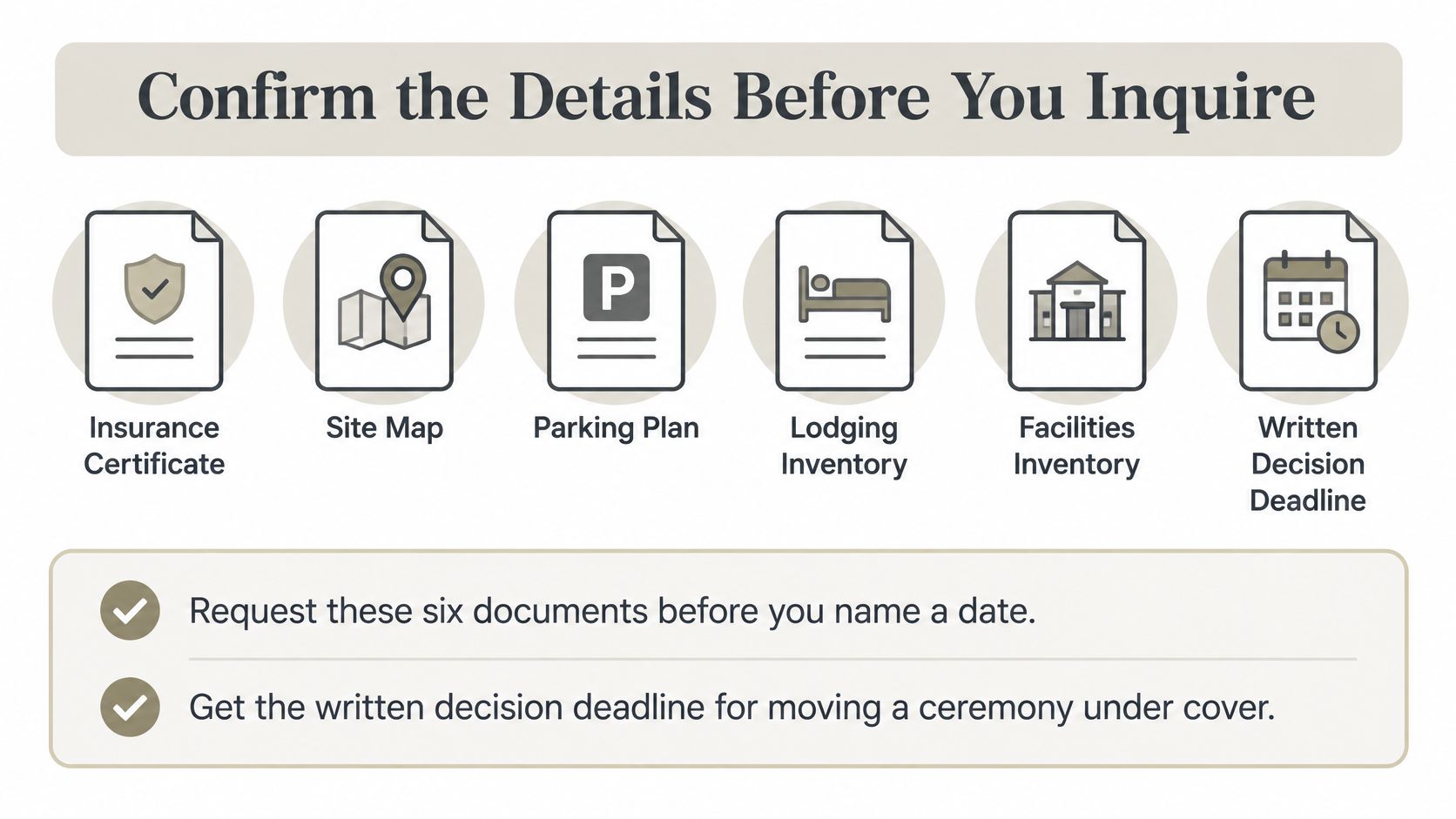
You already have the six document rows. Request them before you name a date, along with a facilities inventory, a lodging inventory, and the written decision deadline for moving a ceremony under cover.
Public land shows why vague language fails. Bandelier National Monument requires a special-use permit, limits ceremonies to a two-hour block, keeps sites open to the public, offers no weather protection, and requires applications at least one month in advance. Albuquerque's permitting guidance likewise notes that outdoor events may require advance approval and that amplified sound can trigger a temporary noise-permit requirement. A private rural venue can avoid that federal permit and still face local rules on sound, parking, fire, temporary structures, and access. Measure surfaces, slopes, walking distances, drop-offs, shuttles, cell service, power, and a quiet space. Legal access and practical comfort are not the same thing.
Marriage paperwork before you travel
New Mexico couples must obtain a marriage license before the ceremony. Santa Fe County's clerk states that both applicants generally must appear together with government-issued photo identification, that the state doesn't impose a waiting period or require blood testing, and that a license purchased in one county may be used anywhere in the state. The signed license must be returned to the issuing county clerk within 90 days.
The standard fee is $55, but payment rules differ. Grant County lists a $55 application fee payable by cash, debit, or credit card, while Lea County specifies that its $55 fee must be paid in cash and doesn't accept checks or credit cards. Bernalillo County also lists a $55 fee and requires two current forms of government-issued identification for each person. Confirm the clerk's payment method, identification rules, hours, and appointments before you drive from Santa Fe, Albuquerque, Colorado, Texas, Arizona, or farther.
Witness rules aren't uniform. Sandoval County requires two witnesses over age 18 to attend and sign the license with the judge. Arrange eligible witnesses in advance. Don't assume guests, vendors, or a photographer qualify.
Day-of cleanliness belongs in the same packet. The opening-day hygiene guide for venue planners is a useful pass over restrooms, handwashing, and high-touch surfaces once the documents are settled.
Taos Goji welcomes inquiries about weddings, retreats, events, and stays. Email taosgoji@gmail.com or call 575.776.3971, then bring the written answers with you. The best site is the one whose answers you can verify in writing.
Our 40-acre historic farm in San Cristobal holds mountain views, historic cabins, a rustic barn, gardens, and outdoor gathering spaces for intimate weddings, elopements, and weekend celebrations. If you're comparing outdoor venues by documents rather than photos alone, start with what we can put in writing. Visit Taos Goji to inquire about weddings, retreats, workshops, or stays.