
Memorial Service Venues in New Mexico, Compared
Cremation now accounts for most deaths in New Mexico, well ahead of burial. If you're planning a service this year, that one shift rearranges the whole question.
A memorial in this state is now more likely to be a gathering held after a cremation than a visitation built around a casket and a same-day burial. The date is yours to choose. The room is yours to choose. The guest list can include a cousin flying into Albuquerque who needs a bed near the ceremony and an aunt in Taos who needs a level path from the car to a chair.
What doesn't change is the judgment call. A setting has to hold your people, protect the hour, and be reachable by the guests most likely to struggle with the walk. Those three demands, seated capacity, privacy, and access, work as a filter: a venue can be beautiful and still fail one of them. The venue types below are tested against all three, in the order a family meets them.
Table of Contents
- Four Venue Types Compared on the Same Tests
- Why Most New Mexico Memorials Now Follow Cremation
- How Many People the Room Can Really Hold
- Privacy for Prayer, Meals and a Longer Farewell
- An Access Audit for Mountain and Rural Ground
- What a San Cristobal Farm Gathering Can Hold
- Confirm the Gathering Before You Inquire
Four Venue Types Compared on the Same Tests
Almost every memorial in Northern New Mexico happens in one of four kinds of place. They differ less in beauty than in who controls the calendar, how many people can sit down at once, and who is legally responsible for the remains.
| Setting | Privacy | Capacity cue | Access and weather | Who handles remains |
|---|---|---|---|---|
| Licensed funeral chapel | Shared building, scheduled privacy | At least 600 sq ft and 60 seats | Indoor routes built for gatherings | Licensed funeral establishment |
| Church or community hall | Shared calendar, varies by room | Posted occupancy, not the chapel rule | Often ramps and restrooms, confirm both | Family with funeral director |
| Public land or roadside | Little privacy, open to passersby | Uncontrolled crowd | Terrain, permits, and weather vary | Person controlling disposition plus landowner or agency |
| Private farm or retreat | Single-group booking | Confirm real seated count, chapel rule does not apply | Check paths, backup room, and lodging | Funeral director or crematory, not the venue |
Reading a Memorial Against a Funeral
New Mexico's funeral rules describe a memorial service as a gathering that recognizes a death without the deceased's body present. That is a narrower thing than a funeral with visitation, embalming, and a casket in the room (state funeral establishment rules). Planning content often blurs the two, then hands families a funeral-home package when what they wanted was a Saturday afternoon of photographs and stories. The distinction decides which building you need.
Reading Each Row in Order
Licensed funeral chapel. Purpose-built, staffed, and predictable. Privacy is partial, because the building serves other families the same week and your hour is scheduled rather than owned. If the day requires a casket present or a viewing, this row is where you stay.
Church or community hall. Often the warmest fit, since ceremony and a meal can happen under one roof. The calendar is shared with potlucks and quilters, so ask when you can get in the night before, and read capacity from the posted occupancy limit rather than from an estimate in a blog post.
Public land or roadside. Rooted here and almost impossible to control. Passersby come with the territory, weather comes with the terrain, and leaving or scattering anything on public ground needs permission from the managing agency, and from the owner if the land is private.
Private farm or retreat. One group on one piece of ground, from the ceremony through supper and into the evening. This row is not held to the chapel standard, and it should never be described as handling the body, transport, or permits. That work belongs to the funeral director or crematory.
The row you circle first: a casket in the room points to a licensed funeral establishment. A ceremony without the body, one family, one property, points to a private venue, with a licensed provider still handling the remains.
Circle the row that matches your day, then test it on capacity, privacy, and access before you commit to a date.
Why Most New Mexico Memorials Now Follow Cremation
A memorial after cremation turns the planning question toward the living: where can the people gather well. Across New Mexico, cremation's share of dispositions has risen steadily over the past decade while annual deaths have also increased, so more families now face exactly that question.
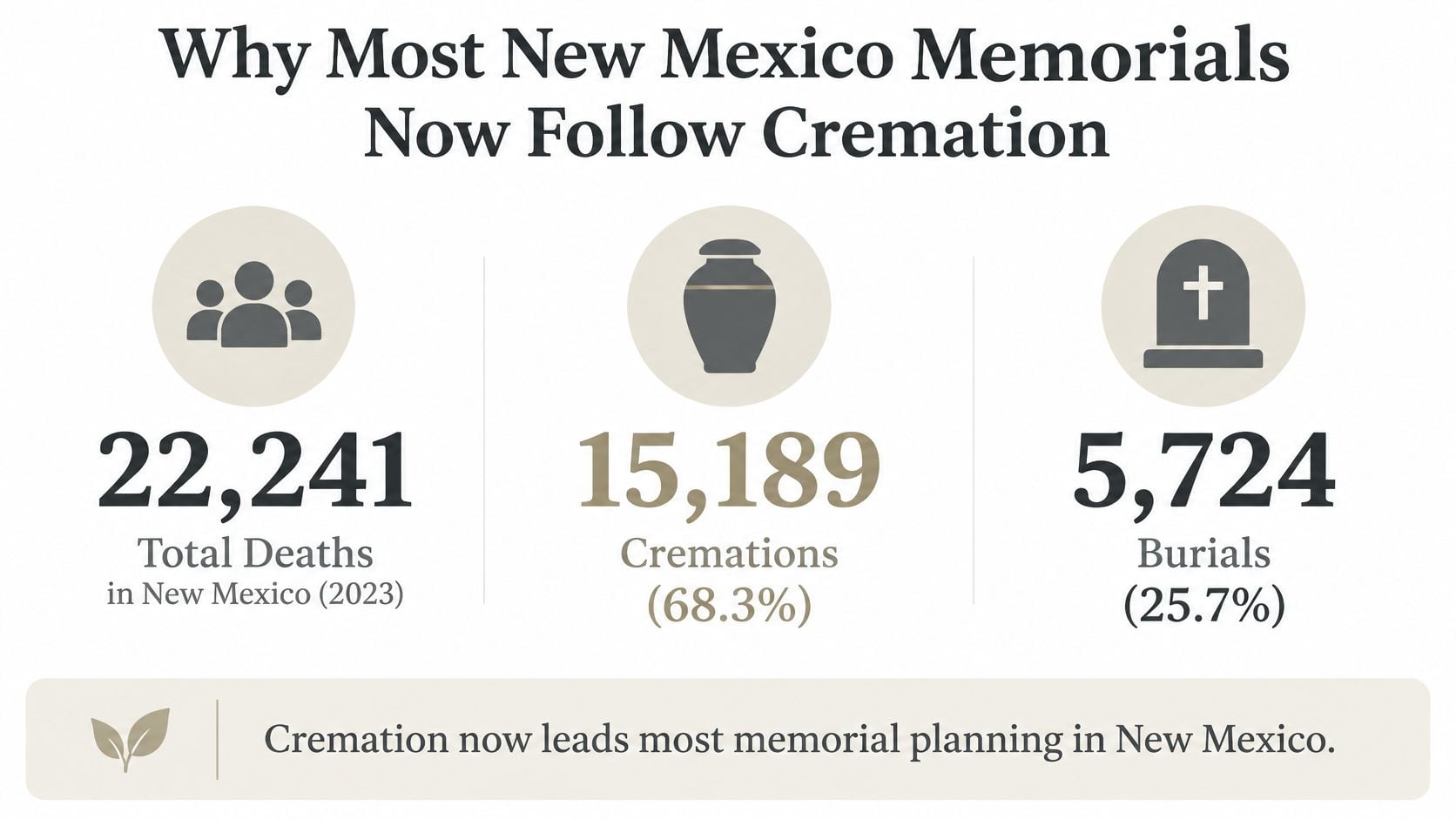
That shift changes what a venue has to do. Once a licensed provider has cared for the body elsewhere, the room no longer has to serve as a chapel with a casket at its center. It works more like a family reunion held during a hard week: people need chairs that fit them, a measure of quiet, and a way to stay close once the formal part ends.
Hold each venue to the same three tests:
- Privacy: can your group be alone with its grief for an hour, without sharing a hallway with another family's service?
- Seated capacity: how many people can sit, and how much clear floor remains for an urn table, a musician, and a wheelchair?
- Access: can an older guest or a traveler reach the ceremony, eat a meal, and sleep nearby without a night transfer?
How Many People the Room Can Really Hold
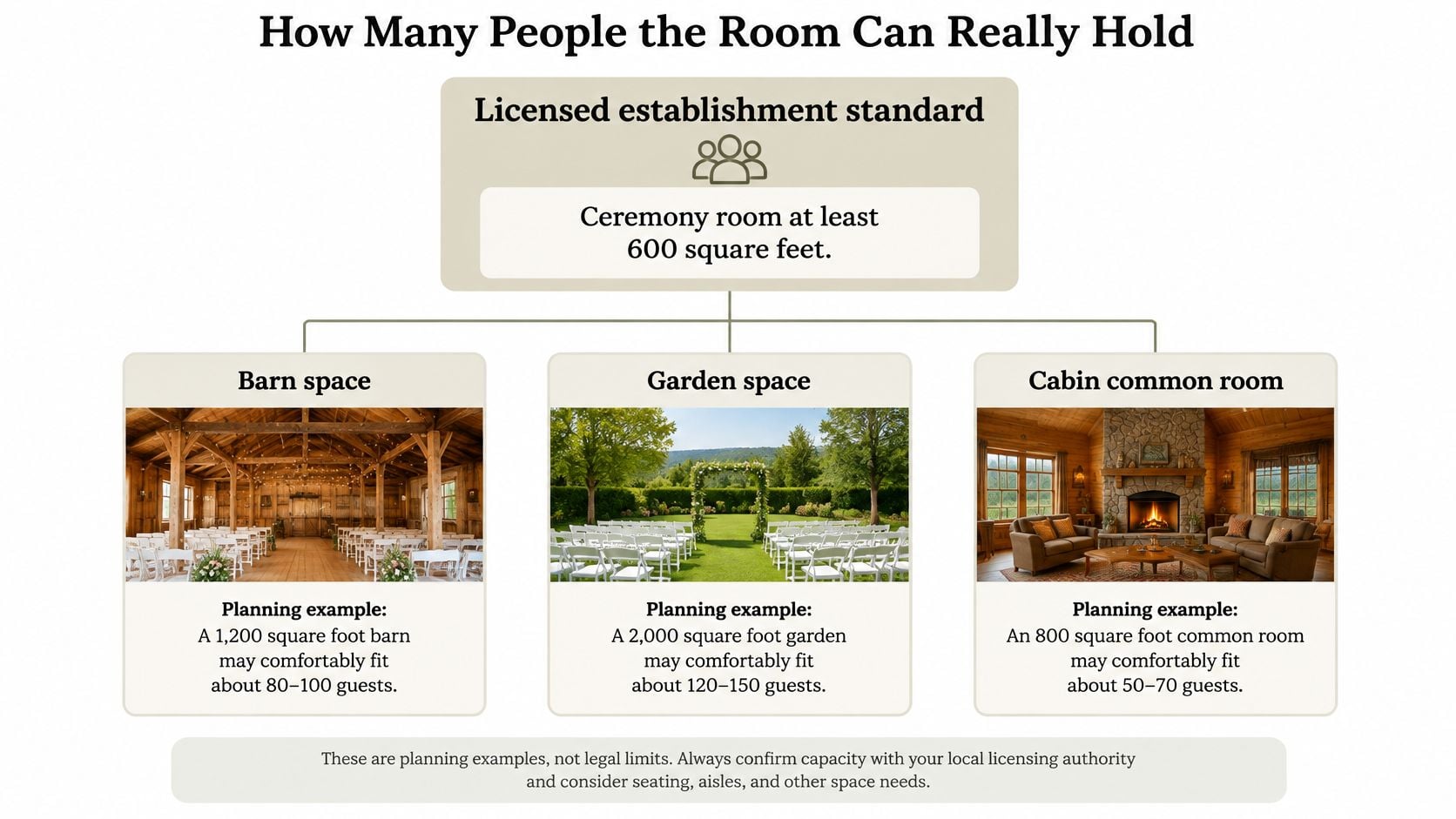
Seated capacity is where the arithmetic of grief gets done badly. A room advertised at eighty, seating forty once a memorial table and a speaker are in place, is a problem you discover on the day with the wrong people standing in the doorway.
The One Number the State Does Set
For licensed funeral establishments, New Mexico sets a floor: a chapel or ceremony room of at least 600 square feet, seating for no fewer than 60 people, space for displaying a casket, good ventilation, and complete separation from the preparation and casket-display rooms except for enclosed entrances and exits (New Mexico funeral establishment standards). That standard applies to licensed establishments. It does not travel automatically to a barn, a garden, or a cabin common room, so those spaces have to be measured rather than assumed.
Think of the square footage as a tabletop and everything else as place settings. Chairs eat the surface. So does a memorial table of photographs, a music stand and speaker, a receiving line at the door, a wheelchair and the chair beside it for a companion, and the path a grandchild needs to reach a great-aunt without climbing over legs. A nominal 600 square feet disappears in good company.
Three Floor Checks
- Usable occupant area. Walk the room with the furniture already in place, not as an empty box. Photograph what's left of the clear floor and compare that to your guest count.
- Circulation. A processional, a greeting line, and a route to the exit all need width. If two people can't pass without turning sideways, the room seats fewer than the fire sign says.
- Ventilation. A service plus a meal runs two to three hours. Ask whether mechanical ventilation or openable windows keep the air moving in a packed room in July and a closed room in January.
Put this in an email: send me the floor plan, the maximum seated count you'll confirm in writing, the distance from seating to the restroom, the number and location of exits, and how the room heats and cools in mid-summer and mid-winter.
Fire occupancy and zoning are separate from funeral licensure, and your local authority answers those questions, not the venue's brochure. Then do the sizing once, plainly: count the seated guests, add a space for each wheelchair and the companion beside it, and look at what remains for the urn table and the door. If the number is negative, you've found a reception space, not a ceremony space.
Privacy for Prayer, Meals and a Longer Farewell
Privacy has a geography. A service, a meal, and a quiet viewing ask for three different kinds of quiet, and many venues supply only one. Northern New Mexico's longer farewells have always assumed as much, moving from a shared meal to a private family viewing to tributes held outdoors. A memorial held without the body present can follow the same pattern anywhere the property keeps each part separate.
What Each Custom Asks of a Room
Turn each habit into a request and privacy stops being a mood word. The ceremony needs a room or a piece of ground where the order of service can change mid-hour without a stranger's meeting starting next door. The meal needs its own space, so guests can eat and talk without rearranging the formal room behind them. A quiet room lets immediate family see the urn privately before the chairs fill. Outdoor ground carries a tribute, a song, or a scattering when the weather agrees.
Remembrance here also lives outside any chapel. The roadside descanso still marks a death at the place where it happened, and a property with walkable ground can hold a smaller version of that instinct: a bench, a planted tree, or a single photograph at the edge of a field.
Inside, one table often does the work of a whole room. If you're building that table, browse tribute photo display setups for arrangements that hold up in low evening light and don't crowd the urn.
Around Taos and Santa Fe, one guest list can carry Hispanic, Catholic, Indigenous, and secular observance in a single hour. Ask the venue directly whether a rosary, a reading, a song, and a stretch of silence can all happen in the same space. Retreat-style grounds, where guests stay overnight and quiet is the product, tend to give a service and a meal separate rooms with open space between them, the pattern you'll see among the retreat and wellness venues in New Mexico.
What the venue decides is narrower than most families assume. Amplified music, outdoor cooking, and scattering each carry their own permission, and the funeral director keeps custody of the remains through the day. Get all three answers in writing early, because they shape the schedule more than any decoration does.
An Access Audit for Mountain and Rural Ground
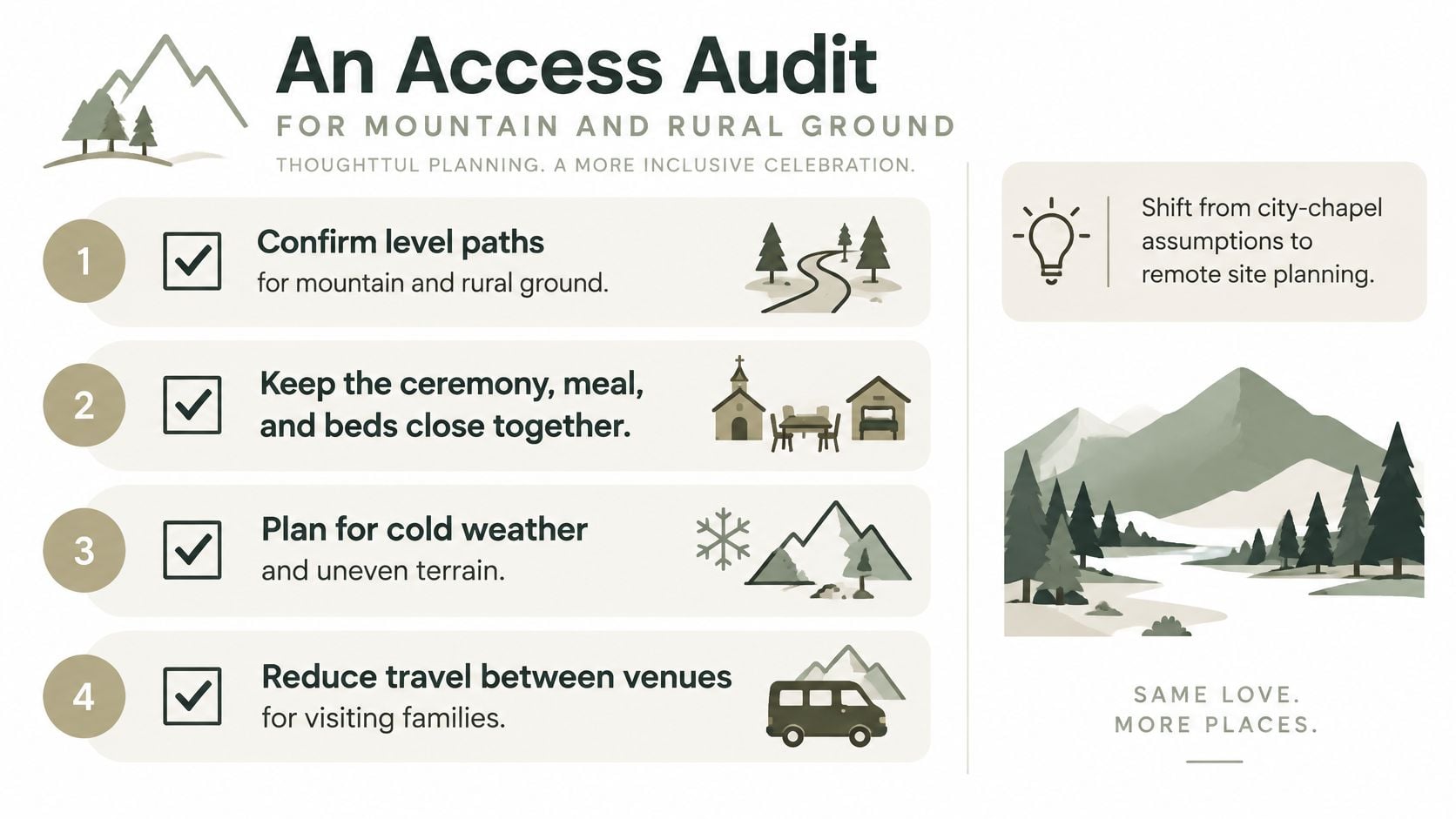
A memorial held without the body present gets judged on three tests: privacy, seated capacity, and access. The first two can be settled with a floor plan and a phone call. Access requires tracing the route a guest with a cane or a wheelchair will take on the day, from car to chair to restroom to bed.
The audit works like a rehearsal. You walk every step in your questions before anyone is asked to walk it in grief, because a property can look affordable until transportation, overnight lodging, a winter contingency, thin cell coverage, a quiet room, and the path from parking to the ceremony are added to the plan (New Mexico memorial planning notes).
Three Questions to Ask First
The path. Can a wheelchair or a walker cross from parking to the ceremony without soft soil, gravel, or a step? Ask for the distance in paces, not a promise that it's close.
The backup. Is there a heated or cooled indoor room if wind, snow, or heat closes the outdoor plan? A backup that seats half the guest list fails the capacity test the moment the weather turns.
The beds. Are cabins or casitas near enough that older guests aren't shuttled after dark? When relatives arrive from Albuquerque, Santa Fe, or out of state, distance between the ceremony, the meal, and the pillow matters more than any view.
Send the remaining checks in writing. An answer on paper outlasts a phone call, and it gives you something to hold the venue to later.
| Check | Why it matters | Ask the venue |
|---|---|---|
| Parking to ceremony | Wheelchairs and older guests | Is the path step-free and firm, and how far is it? |
| Indoor backup | Wind, snow, or heat | Is there a heated or cooled room if outdoors closes? |
| Restrooms | A long service plus a meal | Where is the accessible restroom relative to seating? |
| Lodging on site | Guests from Albuquerque, Santa Fe, or out of state | Are beds close enough to avoid a night shuttle? |
| Signal or internet | Relatives who cannot travel | Can a livestream hold, or is coverage unreliable? |
| Quiet room | Sensory relief during a long service | Is there a room apart from the ceremony? |
| Urn or scattering | Lawful disposition | Who confirms permission, and where does the urn change hands? |
If part of the plan happens outdoors, accessible greenbelt memorial ideas show how level ground, shade, and arranged seating let the setting do the work instead of the props. Rural properties in this region are usually described for weddings first, so the best outdoor wedding venues in New Mexico makes a useful read: the questions are nearly identical, from power and parking to a rain plan.
Safety and accommodation run through the state's funeral services licensing, which addresses reasonable accommodations for people with physical or cognitive disabilities (Regulation and Licensing Department funeral services). A private venue sits outside funeral licensure. The needs of the guests stay the same, and a single property handling the ceremony, the meal, and the beds cuts the number of transfers an older guest makes across the day.
Occupancy and land use are a separate file. The state requires establishments to conform to applicable federal, state, and local statutes, ordinances, and zoning provisions, and a venue marketing memorial gatherings should confirm its permitted occupancy with the local authority rather than relying on a wedding or workshop classification (state establishment rules). For a family weighing a chapel against rural ground, this audit is what turns a shortlist into a decision.
What a San Cristobal Farm Gathering Can Hold
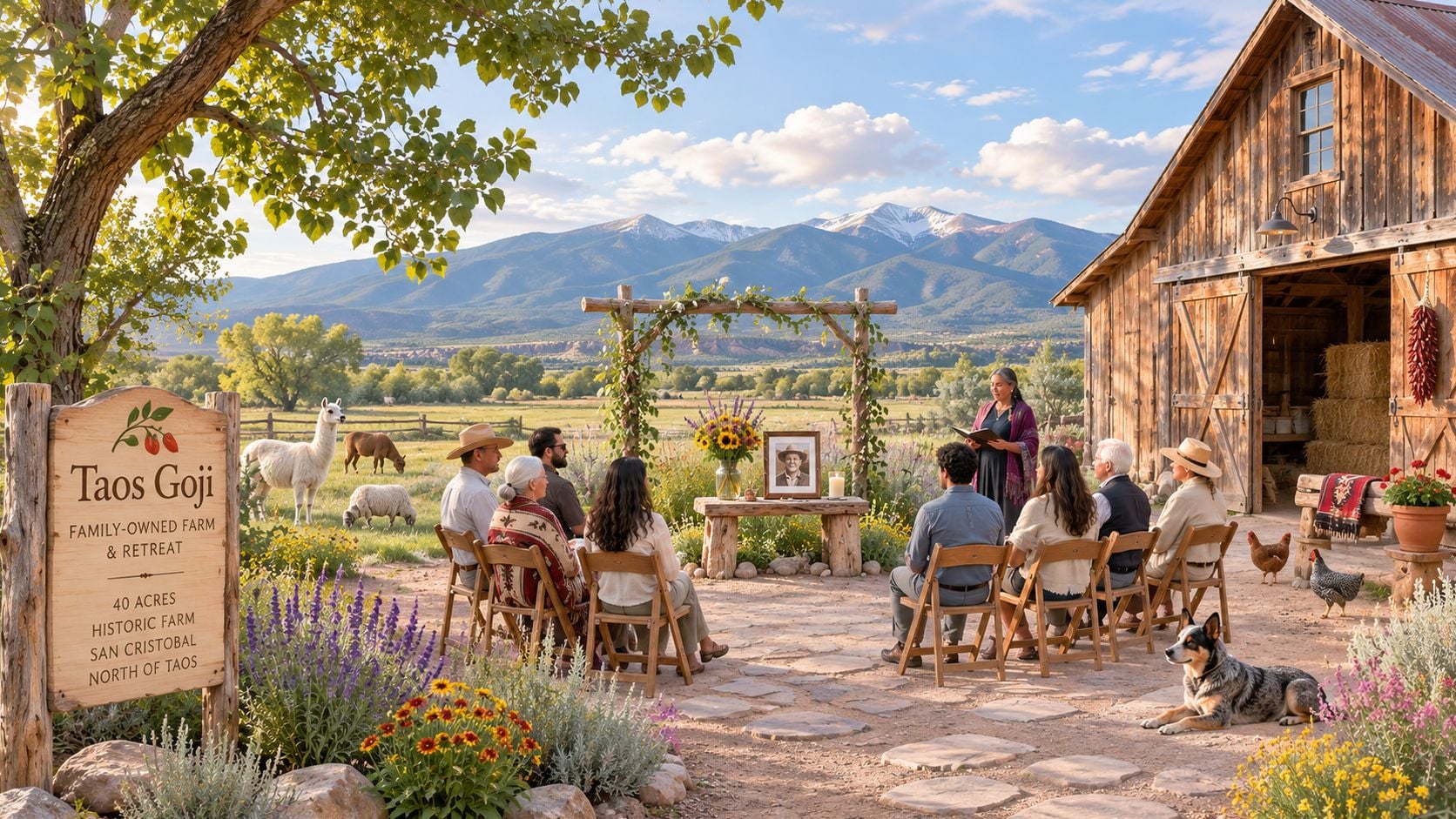
Taos Goji is a 40-acre retreat in the mountains of Northern New Mexico, set in San Cristobal 11 miles north of Taos, with lodging, gathering spaces, and room to slow down. The town matters here. San Cristobal is not Taos, Santa Fe, or Albuquerque, and that distance is part of what gives a small ceremony its quiet.
The historic cabins and casitas answer the first question an access audit asks. Relatives who travel can sleep on the same ground where the service happens, so nobody drives a mountain road at night after a long day. A rustic barn, outdoor gathering space, and mountain views give a remembrance somewhere to sit without turning it into a production.
There is history in the setting too. The property was once a gathering place for artists, writers, and visionaries, and the cabins still carry the names of the people who stayed in them. A farewell built on stories, notebooks, and photographs fits this ground better than one built around a stage.
Acreage buys privacy. It does not confirm capacity or access. Ask how many the barn seats, which path stays level under an older guest's feet, where the nearest restroom sits, and which indoor room holds everyone if the weather turns. Walk the property with that list in hand, and the ground itself answers whether it fits.
Confirm the Gathering Before You Inquire
A venue can only confirm what you can describe. Write four answers down before you call anyone: about how many people will sit, whether the body will be absent, which rituals and which meal need their own space, and who among the guests needs a level path, a quiet room, or a bed close by. Those four answers point to a row in the first table, and they tell a venue whether your day fits its ground.
If the answers describe a casket in a chapel, go back to a funeral establishment. If they describe a later memorial without the body, a single-group rural property is a reasonable inquiry, provided the owner puts occupancy, permission for an urn or any scattering, food, sound, parking, and a weather backup in writing. Cremated remains may be disposed of in any lawful manner by the person entitled to control disposition or that person's agent, but a beautiful setting does not grant that permission (New Mexico disposition rules).
Timing follows the paperwork, not the other way around. Before cremation, the licensed provider completes the signed authorization, the medical investigator's permit or its out-of-state equivalent, any crematory forms, and identification on the outside of the cremation container (cremation documentation requirements). Choose the gathering date after that work is underway. Keep the boundary clear as well: a farm or retreat can host a remembrance without being a funeral establishment, and it should not be represented as providing regulated funeral-home services.
Then send the guest count, two or three dates, access needs, and whether cabins or casitas are required. Ask for the same written answers you used in the comparison: seated capacity, privacy for prayer and the meal, parking and restrooms, an indoor backup, and how the urn is handled. You'll find the property at 1530 and 1528 Old State Road 3, San Cristobal, New Mexico 87564, reachable at taosgoji@gmail.com or 575.776.3971, and the questions to ask a destination wedding venue are the same ones worth asking a memorial venue.
A memorial without the body present asks for one family, one piece of ground, and enough time for a meal and a story after the service. Taos Goji is a 40-acre retreat center in the mountains of Northern New Mexico, 11 miles north of Taos, with lodging, gathering spaces, and room to slow down. If that shape fits your family, visit Taos Goji to see the property and start a conversation about dates, lodging, and what you're planning.