
How to Plan a Wedding Weekend: A Timeline and Guest Guide
You've set a date, and the next question someone asks is how many people are coming. The honest answer is that you don't know yet, and that's fine. What isn't fine is answering it in the wrong order.
A wedding weekend isn't a bigger wedding day. It's a small travel-and-events program with a guest list at one end and a county clerk at the other, and the pieces that break it are rarely the ones couples worry about. A friend who can't afford the trip and never says so. A shuttle manifest that doesn't match the rooming list. A storm that rolls in an hour before the ceremony. A signed certificate still sitting in a tote bag three weeks after everyone flew home.
What follows is the order I'd work in: a backward timeline, headcount and lodging locked early, a day-by-day program that protects rest, weather and altitude plans with named decision makers, county paperwork, transparent guest costs, and the questions to bring to a venue before anything gets signed.
Table of Contents
- Build a Backward Timeline From the Date
- Set the Headcount and Lodging Before Anything Else
- Program the Weekend Day by Day
- Plan for Elevation, Weather and a Backup Space
- Handle the Marriage License and Certificate Steps
- Keep Costs Transparent for Every Guest
- Confirm Your Venue and Send the First Inquiry
Build a Backward Timeline From the Date
A single ceremony needs a venue, an officiant and a caterer. A weekend needs all of that plus beds for two or three nights, transport between lodging and the ceremony site, a welcome gathering, a farewell, and something for guests to do in the hours between. Those pieces all draw on the same room inventory and the same short list of vendors, which is why the runway stretches.
A wedding weekend generally wants a 12- to 18-month timeline, with destination celebrations sitting at the longer end, according to the Aisle guide to wedding planning timelines. The same guide notes that the average U.S. engagement runs about 14 to 15 months and that most couples begin active planning within the first 30 days. Put those numbers together and the conclusion is blunt: a couple who books a rural venue eight months out is planning a wedding day, not a weekend.
Venue and date come first because they determine room availability and set the schedule every other supplier works around.
| When | Milestone | Why It Matters |
|---|---|---|
| 12 to 18 months out | Lock the date, venue, lodging blocks and a preliminary guest list | Room inventory and vendor calendars depend on it |
| 9 to 12 months out | Book major vendors and draft the weekend itinerary | Vendors schedule around the weekend's events |
| 8 to 12 months out | Send save-the-dates, earlier for guests who must fly in | Travelers need time to arrange flights and leave |
| 6 to 9 months out | Concept catering, transport and activities | Sets shuttle capacity and meal counts |
| 3 to 4 months out | Collect dietary, accessibility and arrival details | Feeds catering and room assignments |
| 6 to 8 weeks out | Send formal invitations with weekend details | Guests receive final arrival and dress guidance |
| 2 to 3 weeks out | Freeze headcount, rooming list and transport manifests | Late changes ripple into meals and shuttles |
Save-the-dates normally go out 8 to 12 months ahead and earlier when guests have to fly or request leave. Invitations follow 6 to 8 weeks before the event. On a rural property, add slack for travel distance and seasonal roads, because the drive that's easy in July may not be the drive you get in January.
Once the date is fixed, keep the milestones somewhere both of you can see them. Pretty Progress's wedding countdown and planning guide builds a countdown around the same backward logic, and a visible clock beats a date buried in a spreadsheet.
One structural choice shapes every row above: the scale you're planning. Taos Goji hosts weddings that range from an intimate elopement to a weekend-long celebration, and the size you choose decides how long the lodging block runs and how many vendors need booking.
Give the paperwork its own checkpoint
The marriage license appointment belongs in the final weeks before the wedding rather than months ahead, and the completed certificate still has to reach the issuing county clerk after everyone flies home. Both steps sit outside the ceremony schedule, so give them a separate line on the timeline with a name beside each one. The venue doesn't chase this for you, and an out-of-state officiant won't either.
The rule that holds the rest together: until the venue and the lodging are confirmed, nothing else on the schedule is final.
Set the Headcount and Lodging Before Anything Else
National averages make a poor working number. A 2025 U.S. sample reported about 117 guests, while another planning sample projected 145, as summarized in All Wedding's planning statistics roundup. Neither figure describes your wedding, and planning to one of them is how couples overbook beds and under-order meals.
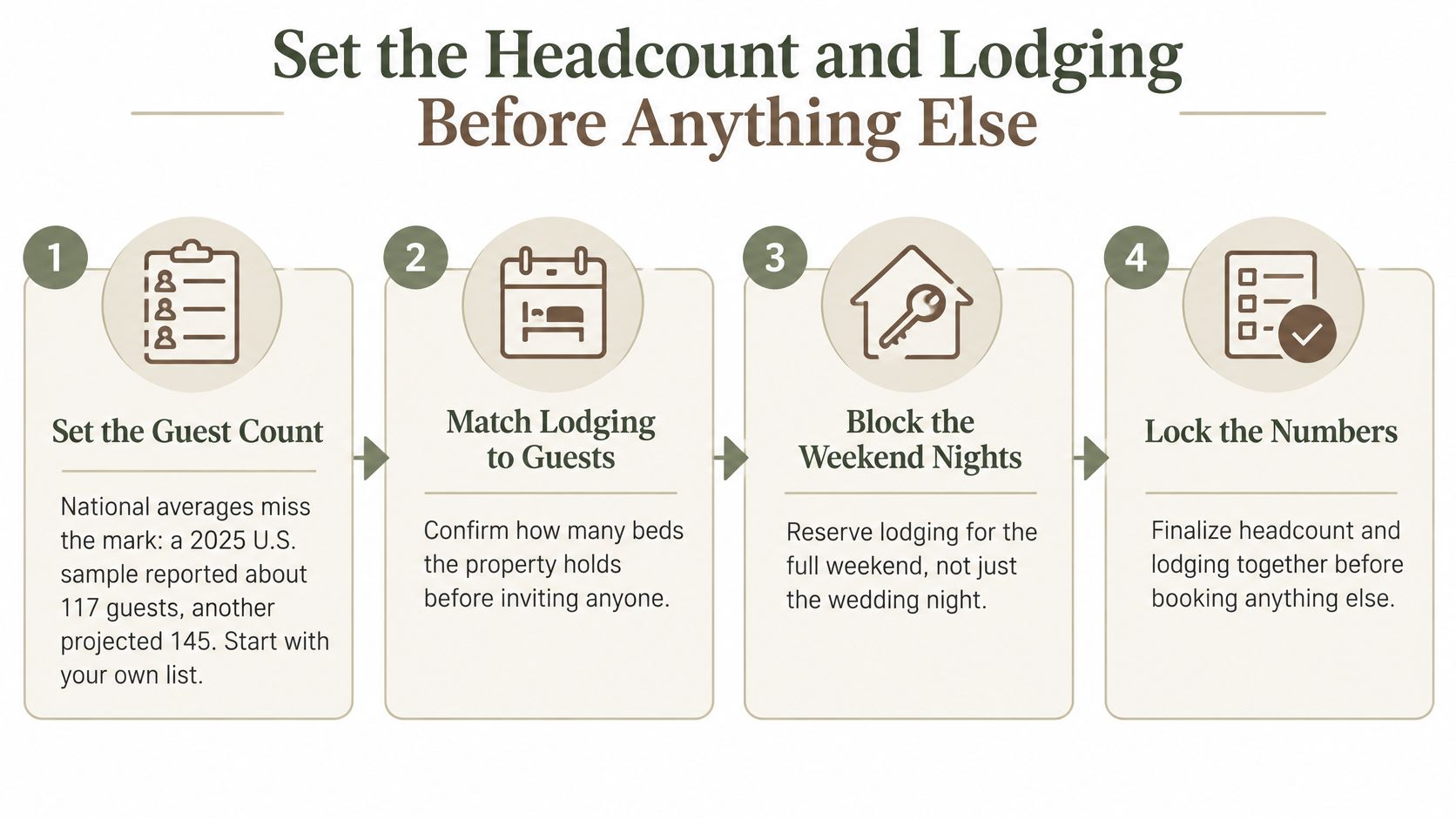
Start with four separate totals instead of one.
- Count each event separately. A welcome dinner rarely draws the same crowd as the ceremony, and a farewell brunch shrinks again.
- Treat the overnight number as the important one. It's usually the smallest total and it drives beds, room blocks and shuttle runs.
- Confirm the sleeping capacity before you invite anyone. Ask how many guests the wedding venue in New Mexico with on-site lodging can house, and reserve against that number with a modest buffer.
- Size the infrastructure to peak population. Parking, restrooms, seating and shuttles answer to the highest headcount on site at one moment, not the daily average.
- Ask two RSVP questions. One about lodging and one about transport, so the rooming list and shuttle manifest come from the same answers. Add a dietary field at the same time, and this guide to collecting dietary requirements for weddings shows how to structure it so nothing gets lost in free-text replies.
- Keep one sheet. Every RSVP, dietary note and room assignment lives in the same file, updated as answers arrive.
The count is ready when the rooming list, the meal count and the shuttle manifest match the RSVP sheet line for line, with no guest left unassigned.
Program the Weekend Day by Day
Destination weddings already behave like holidays. A 2025 UK study found guests expected to take an average of three days off work for one, and 28% said the wedding would become their primary holiday of the year, per Bamni's destination wedding travel report. In the U.S., 61% of destination-wedding attendees said they had or would give up vacation time to attend. Your guests are spending currency that isn't refundable.
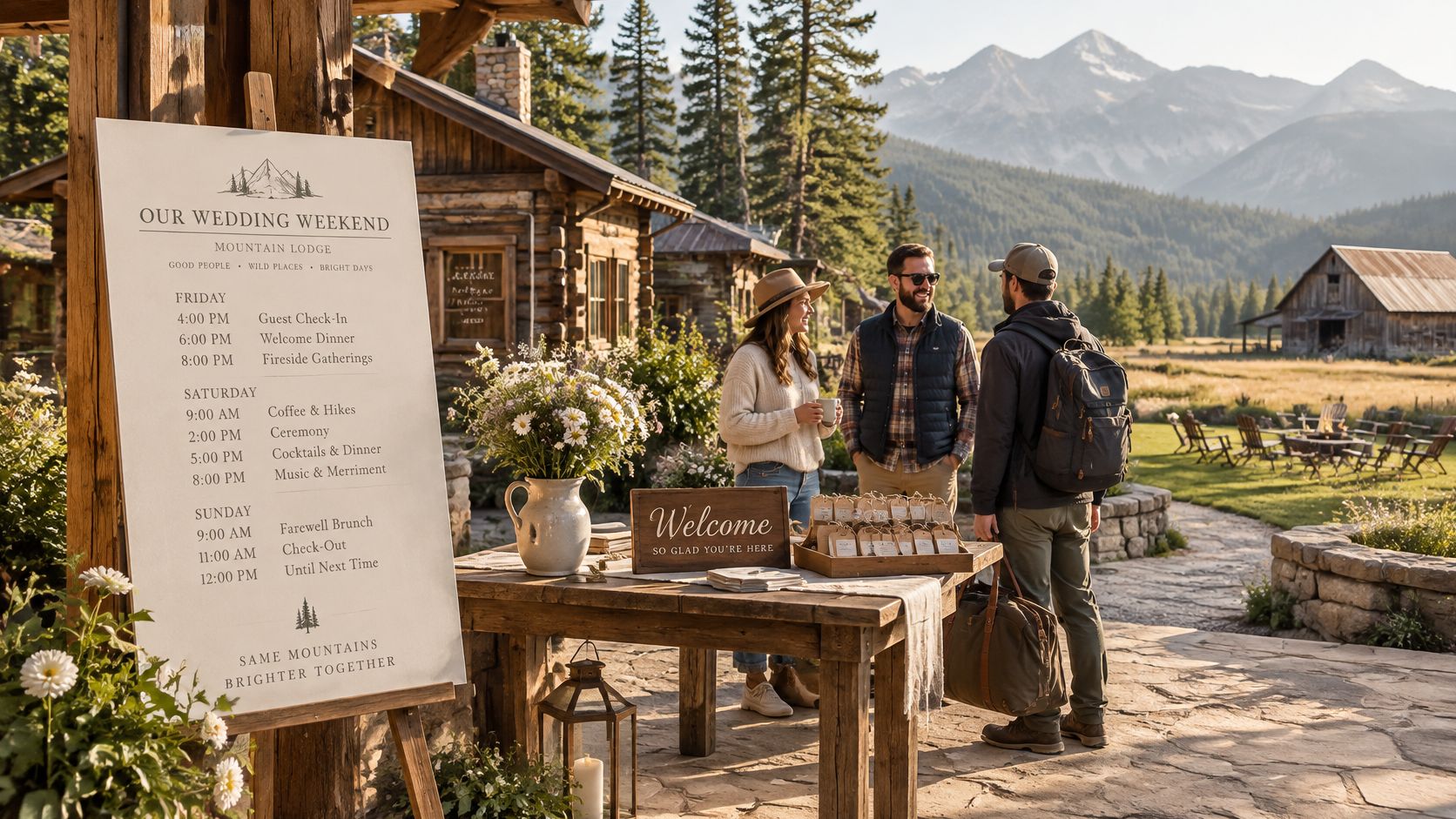
That reframes the job. You're not filling a calendar, you're designing a few days that leave people glad they came. Rest, privacy and open time are hospitality, not gaps to be scheduled over.
| Day | Core Events | Who Attends | Protected Time |
|---|---|---|---|
| Arrival day | Check-in, settling in and an optional welcome dinner | Overnight guests and close family | Late afternoon and an open evening |
| Wedding day | Ceremony, reception and an optional late gathering | All confirmed attendees | Quiet hours after the reception |
| Farewell morning | Optional brunch and staggered departure windows | Overnight guests only | A flexible, unhurried morning |
Protect the space between events
One anchor event per day is plenty. When a welcome dinner, a rehearsal lunch and a sunset gathering stack onto the same afternoon, guests start calculating which one to skip, and the ones who skip are usually the ones managing kids, older parents or a long flight.
Here's a walkthrough of how a relaxed multi-day celebration flows, worth ten minutes before you draft your own schedule:
Set quiet hours after the reception and say so in the guest brief. Reserve a decompression room at the larger gatherings, somewhere a guest can sit down with a crying baby or a headache and not feel like they're leaving. Put arrival buffers around anything that involves a mountain road, and build the itinerary around the slowest traveler rather than the fastest.
Plan for the guests who won't do everything
Some of your people don't drink. Some can't hike at altitude. Some would rather eat breakfast alone than make small talk at a buffet. None of them want to explain it.
Label every side event as optional in plain language, with its own RSVP and its own cost. Offer a nonalcoholic drink that isn't an afterthought. Keep one indoor, seated, low-effort alternative going during anything physical. A rural property with lodging on site makes this easier, because guests can step away for an hour and come back without missing a shuttle.
Guest logistics will consume more of your planning hours than the program itself. An analysis of more than 90,000 wedding-planning tasks counted 4,980 guest-logistics tasks against 3,867 timeline and program tasks, according to That's the One's wedding task analysis. Budget your evenings accordingly.
If you want one personal element inside the program, a custom wedding song drawn from your love story can carry more weight than a dozen printed details, especially at the moment guests are seated and quiet.
Plan for Elevation, Weather and a Backup Space
High-desert ceremonies run on different physics. A Taos climate summary places the area at roughly 6,965 to 6,969 feet, with about 28.4 inches of annual snowfall, snow conditions typically from October through April, and annual precipitation near 12.7 inches, per Taos Goji's guide to northern New Mexico elopement venues. The same summary notes a sharp swing between afternoon and evening temperatures and summer afternoon thunderstorms that can run into September.
Those facts shape the plan more than any color palette. Water, shade, warm layers and wind protection aren't extras at this elevation, and a covered alternative needs to exist before the week of the wedding.
| Condition | Planning Response | Decision Owner |
|---|---|---|
| Afternoon thunderstorms, especially into September | Shorten the outdoor program and move the ceremony under cover | Lead planner, with the trigger set in advance |
| Temperature swing after sunset | Warm layers and wind protection in the guest brief | Venue coordinator |
| Snow season, October through April | Winter-ready access routes and a tested indoor backup | Venue coordinator and transport lead |
| Altitude near 6,965 feet | Water stations, shade and a slower guest schedule | Event planner |
A backup plan that doesn't name a decision maker is a wish. Four things have to be written down: the capacity of the indoor space, the trigger for moving, the person who makes the call, and the route guests and vendors take to get there.
Set the trigger by the morning of. "If the 2 p.m. radar shows storms building, we move at 4" is a decision. Standing in a field debating it at 5:45 is not.
Size the covered space to your peak population, not your expected attendance. Those are different numbers, and the difference is the twenty extra people who drove up from town for the ceremony.
The routes deserve a rehearsal. Walk from the ceremony site to the shelter in the dark, with a phone flashlight, before the weekend starts. Check the winter access road if the date falls between October and April, and brief anyone driving in from Albuquerque or Santa Fe on what the last few miles look like. The outdoor wedding venues in New Mexico worth booking will have walked that route themselves and can tell you where the wind comes from.
Handle the Marriage License and Certificate Steps
The license has to be in hand before the ceremony, and the couple owns that errand. Venues host; they don't file. Treat it as a task with a date, an owner and a document, not a formality someone remembers on the morning of.
- Confirm which county issues it. The county where you apply and the county where the ceremony happens aren't always the same, and office hours vary.
- Book the appointment close to the wedding. Bernalillo County's clerk guidance says the license is available immediately and New Mexico imposes no waiting period after issuance, so there's no reason to apply months early and risk losing the paperwork, per the Bernalillo County Clerk's marriage license page.
- Bring the right identification. Each applicant needs two current government-issued forms of ID, and both must be at least 18.
- Carry the fee in a usable form. The listed Bernalillo County fee is $55, payable by cash or card, with American Express excluded.
- Get every signature at the ceremony. The couple, the officiant and two witnesses all sign the certificate. Keep a pen that works and one spare.
- Assign the return. Santa Fe County requires the completed certificate to reach the county clerk, in person or by mail, within 90 days of the ceremony, as stated on the Santa Fe County Clerk's marriage license page. Name the person who does it before the weekend, because it won't be the couple on a delayed flight.
- Keep proof. Photograph the signed certificate and keep the delivery confirmation.
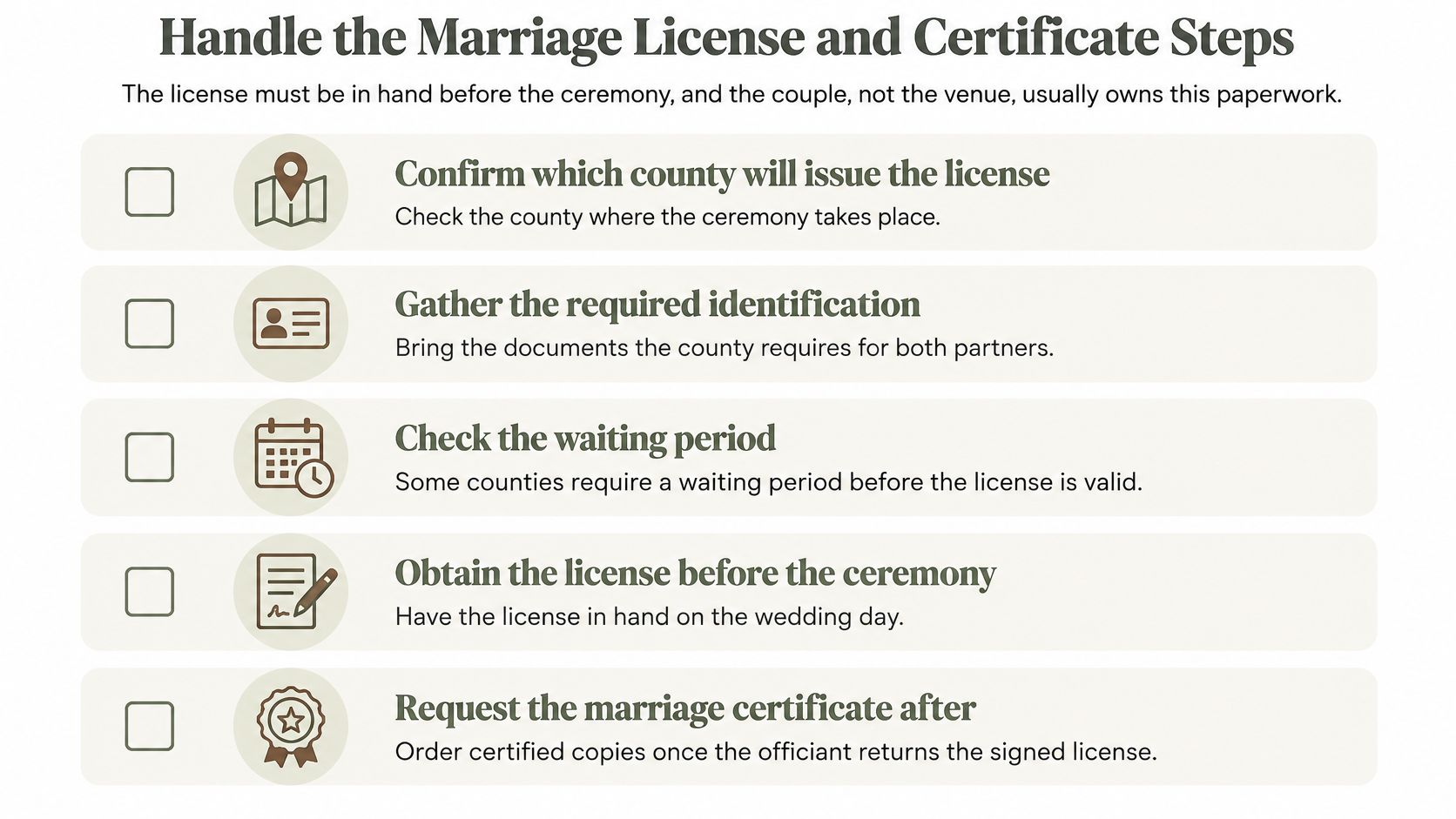
A beautiful weekend doesn't complete the legal record by itself. When the officiant flies home to another state and the couple leaves for a honeymoon, the return is the one item still open, and it's counted from the ceremony date rather than your departure date.
Keep Costs Transparent for Every Guest
More activities don't make a better weekend. They make a more expensive one, and the bill lands on people who may not be able to carry it. 57% of surveyed U.S. adults aged 18 to 44 said they had declined a destination wedding because travel and lodging were too expensive, and 42% said they had lost a friendship because someone couldn't afford to attend, according to Credit Karma's commentary on wedding costs.
Now add the number. A 2025 survey found guests attending an out-of-town wedding expected to spend an average of $1,989 on lodging and transportation alone, from the same Credit Karma analysis. That figure moves people's decisions before they ever see your registry.
So build a guest-cost architecture and publish it early.
- Decide which events are free. Usually the ceremony and the core reception. Everything else gets a price label or gets dropped.
- Share a cost range with the save-the-date. Not a final number, a range for lodging and transport, so guests can plan without asking you a difficult question.
- Offer lodging in tiers. One block at one price forces everyone into the same spend. Two or three options at different distances solve it.
- Coordinate shared rides from the nearest airport or town, and say who to contact.
- Route assistance through a neutral form. If you're helping with lodging, transport or childcare, use a checkbox on the RSVP rather than a conversation, so no guest has to disclose hardship.
Per-person math helps the couple too. Couples married in 2025 spent an average of $292 per wedding guest, per The Knot Worldwide's 2026 Real Weddings Study as summarized by Gaugius, which turns every added event into a number you can see before you commit to it.
Confirm Your Venue and Send the First Inquiry
A good inquiry does half the venue's work for them and gets you a useful answer instead of a brochure. Put six things in the first message: a target date window, a headcount range with the expected overnight count, the events you're considering with rough attendance for each, accessibility needs, the per-guest cost range you're planning around, and what you expect for weather backup.
A rural property that holds one celebration per weekend either has your window open or it doesn't, so send this before any other deposit goes out. Ask how many guests the cabins can sleep, how shuttles or shared rides would work from town, what quiet hours apply, and where guests and vendors shelter if the sky turns. Working through the questions to ask a destination wedding venue first keeps the reply concrete instead of promotional.
Taos Goji sits on a 40-acre historic farm in San Cristobal just north of Taos, New Mexico, welcomes inquiries about weddings, retreats, events and stays, and offers Rustic Farm & Barn wedding packages for celebrations of very different sizes. The property is a destination wedding venue surrounded by mountains, open skies and New Mexico beauty, with historic cabins, a rustic barn and outdoor gathering spaces. Before you commit, compare those answers against your day-by-day schedule and your freeze date. If the overnight capacity doesn't cover the guest list, the weekend changes shape.
The venue and the lodging decide the rest of the weekend.
Taos Goji hosts everything from an intimate elopement to a weekend-long celebration on a 40-acre historic farm north of Taos, with Rustic Farm & Barn wedding packages, historic cabins and gathering spaces set among mountains and open skies. If you're planning a high-desert weekend and want one property to hold the ceremony, the lodging and the quiet hours in between, visit Taos Goji and send an inquiry with your date window and headcount. We'll tell you what fits.